Walls of Genoa, Defensive wall system in Genoa, Italy
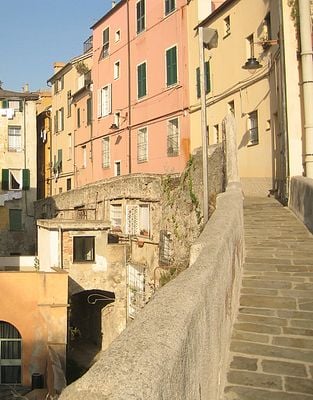
The Walls of Genoa consist of seven successive wall circuits built from the 9th century onward, from the Carolingian ring of about 20 hectares to the 17th-century Mura Nuove along the hill ridges. Surviving stretches include the 12th-century Porta Soprana and Porta dei Vacca, the 16th-century Porta Siberia by Galeazzo Alessi, and the star-shaped bastions of the Doria modernization.
Construction began in the 9th century and continued through later centuries with major additions made as military needs evolved. Each building phase reflects the defense strategies that Genoa required at different points in its history.
The walls' Ligurian name is miage de Zena, and their gates still carry the names of the districts they served, such as Porta Soprana on the hill of Sant'Andrea and Porta dei Vacca. Two of the three monumental 12th-century gates survive; the third, Porta Aurea, was demolished in the second half of the 20th century.
The best way to explore the walls is to hike along the marked paths that run across the top of the fortifications, offering views of the city and port below. Wear comfortable hiking shoes since some sections are steep and the surfaces can be uneven.
Genoa has more and longer walls than any other city in Italy. The Mura Nuove, built in the first half of the 17th century along the hill ridge, are the last and largest ring; arriving by train or car from the north, the first structure visible is the mass of Fort Diamante above the left bank of the Val Polcevera, soon followed by Fort Fratello Minore and, on the distant ridge, Fort Begato up to Fort Sperone on Mount Peralto.
The community of curious travelers
AroundUs brings together thousands of curated places, local tips, and hidden gems, enriched daily by 93,269 contributors worldwide.