Durazzo-Pallavicini Palace, Baroque palace in Via Balbi, Genoa, Italy.
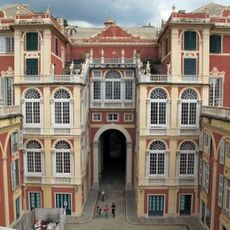
The Durazzo-Pallavicini Palace, also called Palazzo Gio Agostino Balbi, stands at Via Balbi 1 in Genoa. Bartolomeo Bianco designed it in the early 17th century with a U-shaped plan fitted onto a triangular plot. Its courtyard holds a core of diverging stairs, kept apart from the monumental staircase, and the outdoor spaces are split east and west so the hanging gardens along the street come into view gradually.
Bartolomeo Bianco designed the palace in the early 1600s for Gio Agostino Balbi. Marcello Durazzo purchased the property in 1710, which led to the name it carries today.
The palace holds one of Italy's most important private picture galleries, with works by Titian, Rubens, Van Dyck, Guercino, Ribera and Bernardo Strozzi, whose Portrait of a Bishop is cited in the sources. Its monumental archive gathers the papers of families that shaped Genoa's history; Giacomo Filippo Durazzo's 18th-century library and manuscript collection was recently moved to Palazzo Durazzo Pallavicini in Luccoli.
The palace stands at Via Balbi 1, at the corner where the street opens toward Piazza Acquaverde and Genoa's Principe station. Enter from Via Balbi; the courtyard with the diverging staircases is the reference point for orientation. The hanging gardens are best seen from the street, looking up along the east and west outer spaces.
The building combines architectural elements from two different streets and features an innovative staircase system that separates different sections of the palace. This unusual design allows the palace to be accessed from two separate sides.
The community of curious travelers
AroundUs brings together thousands of curated places, local tips, and hidden gems, enriched daily by 94,393 contributors worldwide.