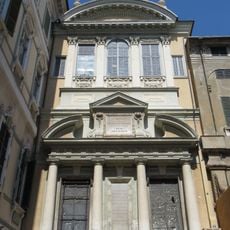
San Sisto, Neoclassical church in Genoa, Italy.
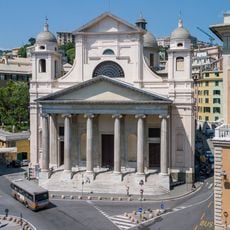
San Sisto is a church building designed in the Neoclassical style with a symmetrical facade and columns made from local stone. The interior features altars, religious artworks, and architectural details that showcase early 19th-century ecclesiastical design.
A Romanesque church stood here from 1088 to 1093, built to mark the Genoese and Pisan naval victory over an Arab fleet at Mahdia on 6 August 1087, the feast day of Pope Sixtus II. It passed to Benedictine monks of the Sacra di San Michele from 1095 until 1479, except 1217–1241. After 18th-century restoration it was demolished in 1825 for the new via Gramsci road and rebuilt in Neoclassical form by Giovanni Battista Resasco and Pietro Pellegrini, opening in 1828.
The church is dedicated to Pope Sixtus II because the naval battle of Mahdia, won by Genoa and Pisa on 6 August 1087, fell on his feast day. A popular legend instead traces the dedication to a chapel built in the 3rd century where the martyr was said to have landed on his way from Spain to Rome with the deacon Lawrence.
The church stands on the seaward side of via Prè, a short walk from Genova Piazza Principe station. The plan is a Greek cross inside a circular shell, so you can circle the nave and keep the frescoed dome and Corinthian pilasters in view. The 2005 conservation work by the Ligurian Superintendency renewed the Neoclassical facade and interiors.
The church has a circular plan on a Greek cross, crowned by a large dome whose frescoes were painted by Michel Cesare Danielli; Pietro Pellegrini built the dome and Giovanni Battista Resasco added the Corinthian colonnades. The marble statue of Saint Sixtus on the main altar, carved by Giovanni Battista Cevasco, was placed there in 1856 and donated by Marquis Ignazio Alessandro Pallavicini.
The community of curious travelers
AroundUs brings together thousands of curated places, local tips, and hidden gems, enriched daily by 92,790 contributors worldwide.