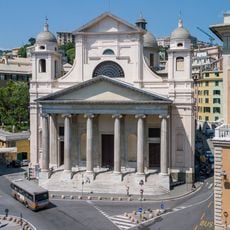
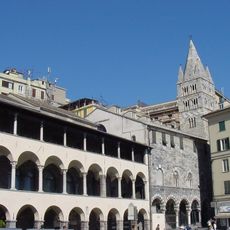
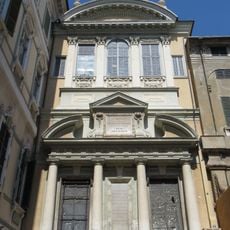
Santi Vittore e Carlo, Baroque church in Via Balbi, Genoa, Italy.
Santi Vittore e Carlo is a Baroque church on Via Balbi, opposite the Royal Palace and beside the university building. Because the ground slopes steeply, the floor is raised and reached by a two-flight staircase; the single nave has a Latin-cross plan, six side chapels and a dome over the crossing. Most decoration dates from 1890–1898 under Maurizio Dufour, except Domenico Parodi's Virtues in the dome pendentives.
The Discalced Carmelite P. Agatangelo di Gesù e Maria, born Giovanni Agostino Spinola, bought the land and funded the church, begun in 1629 on a design by Bartolomeo Bianco. Bianco left the works in 1631 and the friars finished them alone, inaugurating the church on 4 November 1635; it was fully completed in 1673. In 1799 it replaced the parish of San Vittore, whose title was added, and two air raids in May 1944 damaged it badly.
The church keeps the wooden Madonna della Fortuna, a 17th-century figure said to have been the figurehead of an Irish ship wrecked in Genoa's port on 17 January 1636. Recovered by two inhabitants of Prè, it was crowned on 17 January 1637 and moved here from San Vittore in 1799. The Discalced Carmelites officiated until 1974.
Planning a visit becomes easier when you know this church sits near other cultural sites in Genoa's historic center. It helps to watch for the signage along Via Balbi and check opening hours in advance, as these can change seasonally.
The wooden Madonna della Fortuna, a 17th-century statue from the demolished church of San Vittore, is said to have been the figurehead of an Irish ship wrecked in Genoa's harbour on 17 January 1636. Two residents of Prè recovered it; after a child's fall was attributed to it, Pope Urban VIII confirmed the miracle and the statue was crowned on 17 January 1637.
The community of curious travelers
AroundUs brings together thousands of curated places, local tips, and hidden gems, enriched daily by 92,622 contributors worldwide.