Palazzo Barbieri, Neoclassical town hall in Piazza Bra, Verona, Italy
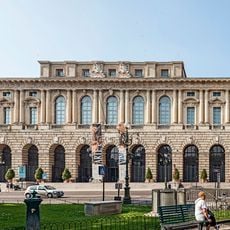
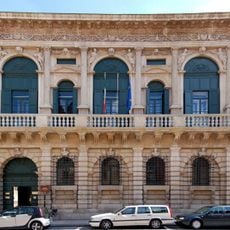
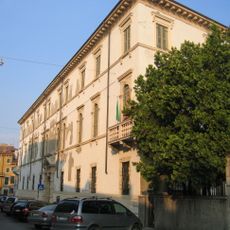
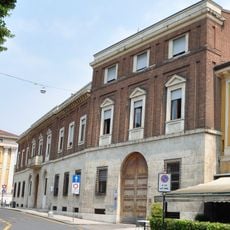
Palazzo Barbieri is the city hall of Verona, standing on the eastern side of Piazza Bra, the city's main square. It is built in yellow stone and features a long colonnade of Corinthian columns topped by a triangular pediment.
Construction began in 1835 on the site of the demolished Misericordia hospital and the Sant'Agnese district, to a design by Giuseppe Barbieri; after his death Francesco Ronzani completed it in 1851. Planned as the seat of the Civic Guard, it instead housed the Imperial Royal Command of city and fortress. From 1869 municipal offices moved in, and in 1874 it became Verona's town hall. Restored 1947–1950 after 1945 bombing.
The Sala del Consiglio displays a large 1595 canvas by Felice Brusasorzi showing the Veronese victory over the Benacensi in 829; Alessandro Turchi, Pasquale Ottino and Sante Creara also contributed. The Sala degli Arazzi holds two 16th-century paintings, including Paolo Farinati's Victory of the Veronese against Frederick Barbarossa of 1164 and a Last Supper from Veronese's workshop. The Sala di Rappresentanza has two views of Piazza delle Erbe, by Carlo Ferrari (1839) and Angelo Dall'Oca Bianca (1903).
The building is still a working town hall, so not all areas are open to visitors at all times. The facade and portico can be seen freely from the square, while access to interior rooms depends on what is happening inside on any given day.
Built into the wall near the entrance is a 14th-century fresco showing the Crucifixion and the Virgin Mary, which was originally taken from a private home. It is still visible today, though most visitors walk past it without noticing.
The community of curious travelers
AroundUs brings together thousands of curated places, local tips, and hidden gems, enriched daily by 92,802 contributors worldwide.