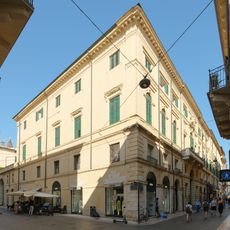
Palazzo dei diamanti, Renaissance palace in city center, Verona, Italy.
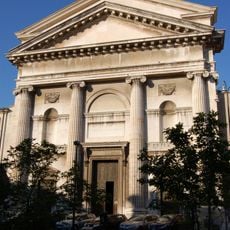
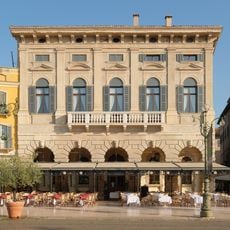
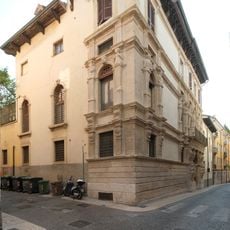
The Palazzo dei Diamanti, also known as Palazzo Sansebastiani, stands at the corner of Via Enrico Noris and Via Anfiteatro. Its ground floor has a portal framed by Doric columns with a broken pediment and winged victories in the spandrels. The piano nobile features two biforas with Ionic capitals and round arches. The diamond-cut rustication covers the facade, and the building is attributed to Bernardino Brugnoli.
A Cappella family house stood on this site from the early 15th century; the family entered the city council and in 1573 was made counts of Salizzole. Camillo Cappella commissioned the late-16th-century rebuilding, largely overseen by his wife Elena Sansebastiani while he was occupied as a jurist and public official. An inscription inside records her and dates completion to 1582, without naming the architect. In 1585 the palace housed the Accademia Filotima; it was damaged in the Second World War and restored by 1950.
The palace takes its name from the distinctive diamond-shaped marble blocks that cover its facade, a design choice that immediately captures attention. This unmistakable feature has become the building's defining visual characteristic throughout Verona.
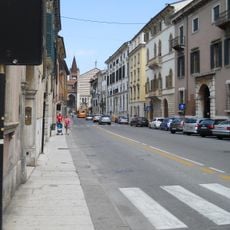
The building is easily accessible on foot in the city center and sits on a busy street with clear orientation. The facade can be viewed from the street, and the location provides a good spot for photographs of the distinctive marble pattern.
The main entrance features Doric columns and a split pediment, an architectural detail that influenced 18th-century design. This early example demonstrates how the palazzo shaped trends that became popular generations later.
The community of curious travelers
AroundUs brings together thousands of curated places, local tips, and hidden gems, enriched daily by 92,930 contributors worldwide.