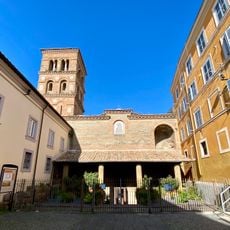
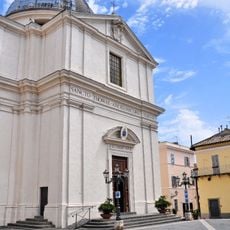
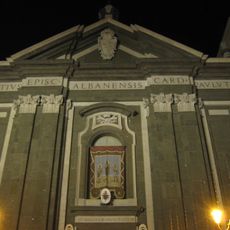
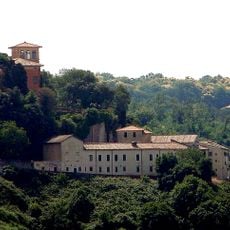
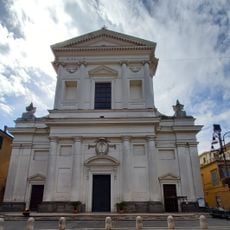
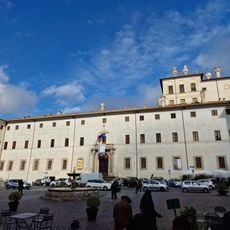
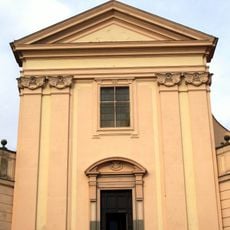
Palazzo Sforza-Cesarini, Renaissance palace in Genzano di Roma, Italy.
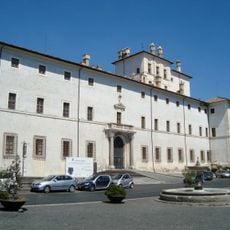
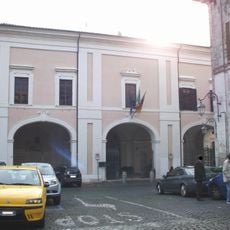
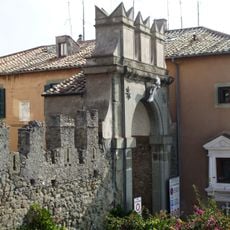
Palazzo Sforza-Cesarini is a noble building in Genzano di Roma whose current form results from early 18th-century work by architects Ludovico and Domenico Gregorini. Its main facade, a reworking of Palazzo Farnese in Rome, has windows that grow smaller toward the outer edges, creating an accelerated perspective and the impression of a surface curved toward the viewer. The portal's capitals, bases and balcony balustrade are geometrically deformed to appear frontal from the road along the Olmata.
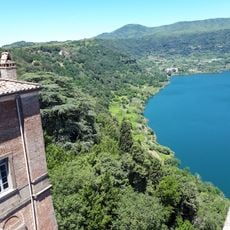
A medieval castle guarding Lake Nemi already existed in the early 13th century. Around 1590 Giuliano II Cesarini bought surrounding houses and land to convert it into a palace, built to the right of today's portal. Between 1713 and 1730 Duke Gaetano Sforza Cesarini added a new lake-facing wing and a storey, giving the symmetrical facade designed by Ludovico Gregorini.
The building brings together ideas from Roman architecture with details that recall the Palazzo Farnese. The facade shows how the Cesarini family expressed their taste and connection to Roman aristocracy.
The palace is the legal and representative seat of the Associazione Nazionale Città del Vino, so the interior is not a museum open to tourists. Visitors can still examine the portal and facade from the street; the geometric deformation of capitals, bases and balustrade is calibrated for someone arriving along the old Olmata avenue. Genzano residents retain the right to pass through the palace gateway.
The main portal is built with a deliberate geometric distortion: capitals, bases and balustrade elements are shaped to appear correct only from the straight road opposite, the Olmata, a trident of tree-lined avenues laid out in the mid-1600s originally with elms. From elsewhere the proportions look wrong.
The community of curious travelers
AroundUs brings together thousands of curated places, local tips, and hidden gems, enriched daily by 94,549 contributors worldwide.