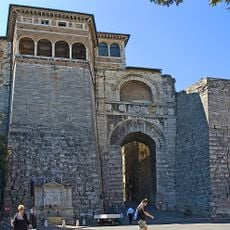
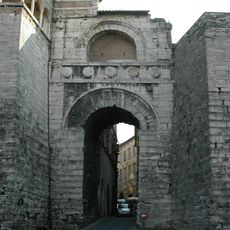
Cassero di Porta Sant'Angelo, Medieval city gate in Perugia, Italy.
Cassero di Porta Sant'Angelo is a medieval city gate in Perugia with a distinctive three-level structure built from different materials: sandstone at the base, limestone in the middle, and brick at the top. The gate now houses a museum dedicated to the city's defensive walls and gates.
The gate was built in 1325 by Lorenzo Maitani as part of Perugia's second city wall, begun in 1321. In 1327 the Abbot of Monmaggiore had it enlarged and turned into a barracks. Between 1416 and 1424 Braccio Fortebraccio restored it to a design by Fioravante Fioravanti of Bologna, and in 1479 it became a small fort with a portcullis, trapdoors and loopholes.
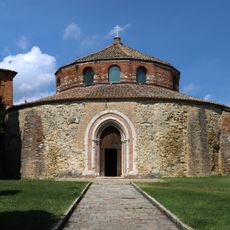
The gate stands at the end of Corso Garibaldi beside the Tempio di Sant'Angelo, in the rione of Sant'Angelo, and takes its name from that church. The gate appears in the Gonfalone della Giustizia painted by Perugino between 1496 and 1498, now in the Galleria nazionale dell'Umbria. Since 1988 it has housed a display anticipating a museum of musical instruments, with original scores by Carlo Dardocci and Angelo Galimberti, table fortepianos, Baroque and 19th-century flutes, lutes and 19th-century guitars, managed by the Associazione Arte & Musica nelle terre del Perugino.
Visitors can explore the museum inside the gate and enjoy views from the roof terrace overlooking the city. The gate is easily accessible and provides a good starting point for understanding Perugia's medieval defensive system.
The gate appears in the Gonfalone della Giustizia, a banner painted by Perugino between 1496 and 1498 and now kept in the Galleria Nazionale dell'Umbria. Look for the gate in the painted cityscape, a rare record of its medieval appearance.
The community of curious travelers
AroundUs brings together thousands of curated places, local tips, and hidden gems, enriched daily by 94,043 contributors worldwide.