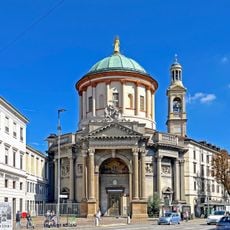
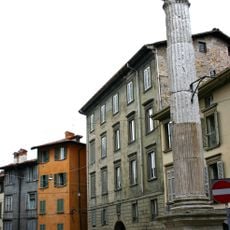
Porta Nuova, Neoclassical city gate in Bergamo, Italy
Porta Nuova is a Neoclassical city gate in Bergamo, made up of two symmetrical stone pavilions that frame a central open passage. It stands at the northern end of Viale Papa Giovanni XXIII, forming the formal entrance to the Lower Town from the main boulevard.
Porta Nuova was built in 1837 in Neoclassical style for the entry of Emperor Ferdinand I of Austria, who visited the city in 1838. It followed a design of 1828 by architect Giuseppe Cusi, with Ferdinando Crivelli assisting in its execution. The gate was inaugurated on 20 August 1837, when the Alessandrina fair opened. Its construction, together with that of Viale Papa Giovanni, required the demolition of the convent and church of Santa Maria delle Grazie.
The gate marks the point where the flat commercial Lower Town gives way to the steep lanes leading up toward the old walled quarter. Passing through it feels like crossing from one world into another, which is something many visitors notice right away.
The gate sits right next to the main train station, making it one of the first things you see when arriving by rail. The entire structure is open and free to walk through at any time of day.
The two stone pavilions were not built purely as decoration but originally served as guardhouses and offices for customs officers checking goods entering the city. Their compact, functional shape still hints at this role, even though nothing of that activity remains today.
The community of curious travelers
AroundUs brings together thousands of curated places, local tips, and hidden gems, enriched daily by 92,943 contributors worldwide.