Pulpit in the Pisa Baptistery, Marble pulpit in the Baptistery, Pisa, Italy
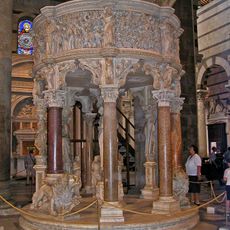
The pulpit in the Pisa Baptistery is a hexagonal marble structure signed and dated 1260 by Nicola Pisano. Six outer columns of dark grey, greenish, reddish-brown and mottled orange-brown marble, several resting on carved lions, surround a central column on three sculpted telamons. Above the trefoil arches and capitals stand statues of the four cardinal virtues, St John the Baptist and the Archangel Michael, and the parapet carries five high-relief panels of the life of Christ.
Nicola Pisano signed and dated the pulpit 1260; work had likely begun around 1255. Its hexagonal plan broke with the square pulpits of the 12th century, such as Guglielmo's in Pisa. Archbishop Federico Visconti probably inspired the programme, and the Franciscan Bonaventura da Bagnoregio preached in Pisa in 1257, shaping the choice of scenes.
The carved panels show five scenes from the New Testament in high relief across the marble surfaces. These biblical depictions served as visual instruction for those unable to read, making scripture tangible within worship.
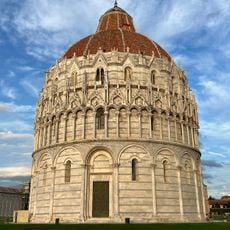
The pulpit stands inside the Baptistery, so it is seen from the floor of the round interior; walking around the central space brings the six sides and the carved lions into view one after another. The panels sit well above eye level, and the upper statues reward a closer look from below.
The Fortitude statue above the capitals is one of the first post-antique nudes drawn from a classical model, recognisably modelled on Hercules with his lion skin. Michelangelo reused its slightly arched pose over 250 years later for his David.
The community of curious travelers
AroundUs brings together thousands of curated places, local tips, and hidden gems, enriched daily by 92,785 contributors worldwide.