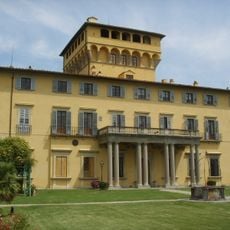
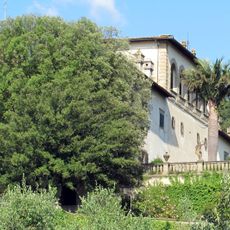
Villa Fontallerta, Renaissance villa in Florence, Italy.
Villa Fontallerta is a compact two-storey villa on the slopes of the Camerata hill in Florence, with a basement level and a long stable wing added in the 19th century along its north-east side. Its south front grew from a 16th-century loggia with a double round-arched arcade under cross vaults, later incorporated into a late-Baroque facade facing an Italian-style garden. Inside, a double-height ballroom with stucco decoration and a surrounding balcony occupies the site of the former courtyard.
In the 14th century the Florentine merchant Filippo di Niccolò Cornacchini owned a palagio on this hillside site. By 1427 the palace was already recorded as "di Fontallerta" in Agnolo di Zanobi Gaddi's Florentine tax return, and the Gaddi held it for about three centuries, commissioning enlargements and frescoes by painters of their own family such as Taddeo and Agnolo. In the late 16th century a loggia, attributed to Ammannati, was added on the south-east side; in the 18th century Marquis Sinibaldo turned the courtyard into a ballroom and built the new façade against it. In 1850 the villa passed to Count Pasolini, who laid out the tree-lined entrance on viale Augusto Righi and the romantic park; it remains with the Pasolini heirs.
In the Decameron (IX, 5) Boccaccio sets the tale of Calandrino, Buffalmacco and the beautiful Niccolosa in the villa's courtyard, which has since disappeared. Traces of the courtyard well remain in the cellars, and a 14th-century fresco of Christ is still visible. The name Fontallerta is documented from 1427, in Agnolo di Zanobi Gaddi's Florentine tax return.
Villa Fontallerta is privately owned by the heirs of the Pasolini family and is not open to the public, so it cannot be visited inside or in its grounds. Visitors reach the area along viale Augusto Righi, on the slopes of the Camerata hill, and can see the villa from the street; the view over Florence opens from this hillside road.
Boccaccio set the fifth novella of the Decameron's ninth day in the villa's courtyard, where Calandrino, Buffalmacco and the beautiful Niccolosa appear. The courtyard itself is gone, but traces of its well survive in the cellars, and a 14th-century fresco of Christ can still be seen.
The community of curious travelers
AroundUs brings together thousands of curated places, local tips, and hidden gems, enriched daily by 92,807 contributors worldwide.