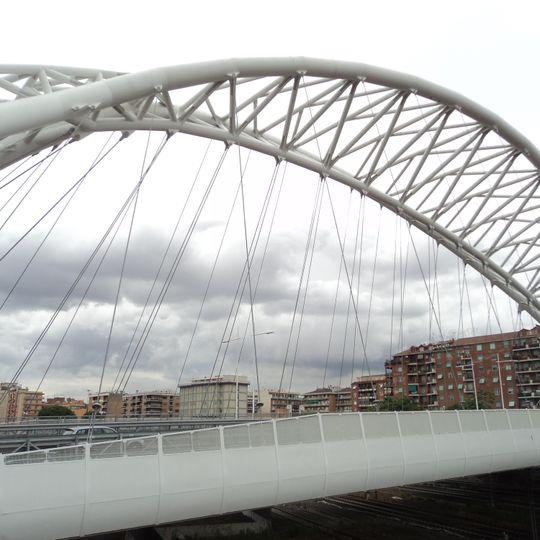
Ponte Settimia Spizzichino, Road viaduct in Ostiense, Rome, Italy
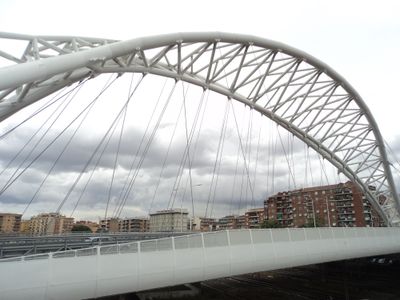
Ponte Settimia Spizzichino is a white steel arch bridge in Rome's Ostiense area, carrying the Circonvallazione Ostiense over the Rome-Lido railway and Metro Line B near Garbatella station. A single tubular arch with a lattice of diagonal and vertical members spans 126 metres, rising 42 metres above the tracks, and thin cables suspend a flat deck with solid white parapets. The structure has two separate carriageways, each 16.5 metres wide with three lanes, plus a 1.5-metre cycle path.
The bridge was planned in Rome's 1962 master plan and confirmed in the 2008 plan, then built over three years and inaugurated on 20 June 2012 at a cost of about 15.4 million euros. The design was by Solidus s.r.l. under engineer Francesco Del Tosto, with Cimolai SpA as contractor. On the proposal of the Municipio VIII council it was named after Settimia Spizzichino, the only woman to survive the 16 October 1943 raid of the Roman Ghetto and the deportation of 1,259 people to Auschwitz.
The bridge is named after a survivor of Nazi persecution, serving as a reminder of Rome's history for those who cross it. It has become a symbol of the modern Garbatella neighborhood.
The bridge is easy to reach on foot, by bike, or by car with separate pathways for each type of traffic. It is best visited during the day to clearly see the details of the white structure.
The designer drew on Spanish precedents: Juan José Arenas de Pablo and Marcos Jesús Pantaleón Prieto's Puente de la Barqueta in Seville, and Santiago Calatrava's Alameda bridge in Valencia and Alamillo bridge in Seville. The lattice also echoes the nearby Gazometro and, seen from a distance, the shape of DNA.
The community of curious travelers
AroundUs brings together thousands of curated places, local tips, and hidden gems, enriched daily by 93,345 contributors worldwide.