Faraglioni, Natural rock formations near Capri, Italy.
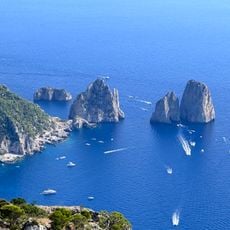
The Faraglioni are three limestone sea stacks off Capri's southeastern coast. The Faraglione di Terra, still joined to the island by a 4-metre isthmus, is the tallest at 111 metres; the Faraglione di Mezzo, 81 metres high, is pierced by a natural tunnel 58 metres long and about 13 metres high; the Faraglione di Fuori, or Scopolo, rises 104 metres and is separated from Mezzo by the 8-metre-wide Saetta passage. The outermost stack is the only habitat of the blue lizard.
The name comes from the Greek faros, meaning lighthouse: fires lit on coastal rocks at night guided sailors and warned of obstacles, and the Faraglioni likely served this role. Karst water carved the rock to 15 metres below today's sea level; later marine erosion and collapses of the vaults shaped the three stacks seen now.
The name comes from the Greek faros, meaning lighthouse: fires were lit on coastal rocks at night to guide sailors. The three stacks are called Faraglione di Terra, di Mezzo and di Fuori (or Scopolo); the narrow channel between the last two is the Saetta. The painter's views of the 1800s and Totò's 1949 film L'imperatore di Capri made them known beyond the island.
The best views come from the Gardens of Augustus, Punta Tragara viewpoint, or aboard a boat circling the island. Go early in the day or when skies are overcast to avoid crowds and get clearer sight lines to the rocks.
The outermost stack, Faraglione di Fuori or Scopolo, is the only habitat of Podarcis siculus coeruleus, a lizard whose throat, belly and tail are blue while its back stays blackish. It descends from the mainland field lizard and took on the blue of sea and sky after the stacks were cut off from Capri.
The community of curious travelers
AroundUs brings together thousands of curated places, local tips, and hidden gems, enriched daily by 93,121 contributors worldwide.