Kosuge Slip Dock, Maritime industrial site in Nagasaki, Japan
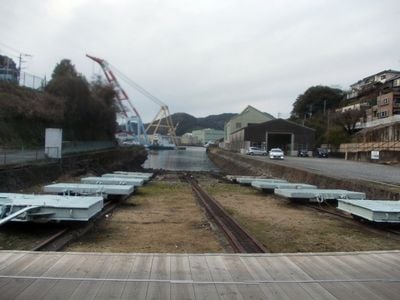
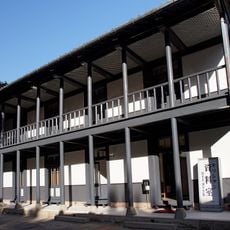
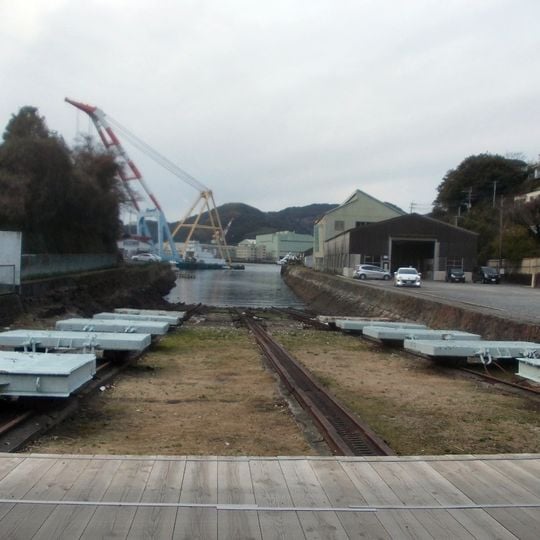
Kosuge Slip Dock is a ship repair facility in Nagasaki, Japan, listed as part of the UNESCO World Heritage Site, and it consists of a Western-style slipway with railway tracks and a brick engine house that once powered the hauling mechanism. The slipway runs from the water up a slope to the land, where vessels could be worked on out of the sea.
Construction began in May 1866 and the dock opened in January 1869, planned by Satsuma Domain figures Komatsu Kiyokado and Godai Tomoatsu with Scottish merchant Thomas Blake Glover. The Meiji government bought it in April 1869 and placed it under the Nagasaki Ironworks, directed by Hirano Tomiji; the Ministry of Public Works took over in 1871. Mitsubishi leased it in 1884, owned it from 1887, and closed it in 1920; it was designated a national historic site in 1969 and inscribed as a World Heritage asset in 2015.
Kosuge was the first place in Japan where ships were repaired on dry ground using a Western-style slipway, and the tracks that guided vessels out of the water are still visible today. Walking along them gives a clear sense of how this method worked in practice.
The site sits along the waterfront in the port area of Nagasaki and can be reached from the city center in roughly 20 minutes by bus or taxi. Sturdy shoes are a good idea since parts of the visit involve walking on uneven ground near the old tracks and slipway.
The dock's rails run straight into the sea, and ships were hauled up them by a winding machine made in Britain, still listed among the surviving structures. Because the rails and cradle resemble an abacus, locals call the site Soroban Dock. The dock closed in 1920, reopened as a boat workshop from 1937 and was used until 1953.
The community of curious travelers
AroundUs brings together thousands of curated places, local tips, and hidden gems, enriched daily by 93,388 contributors worldwide.