Ōsaki Hachimangū, Hachiman shrine in Aoba-ku, Sendai, Japan
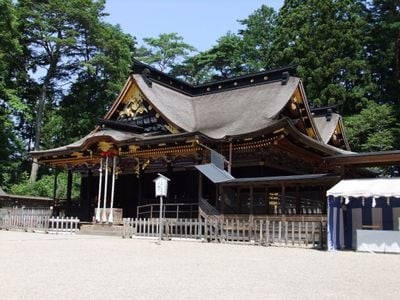
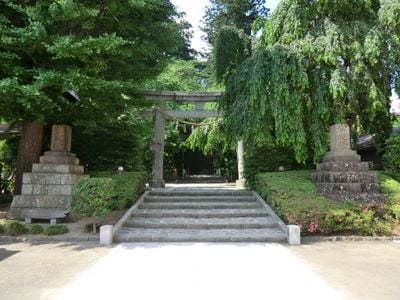
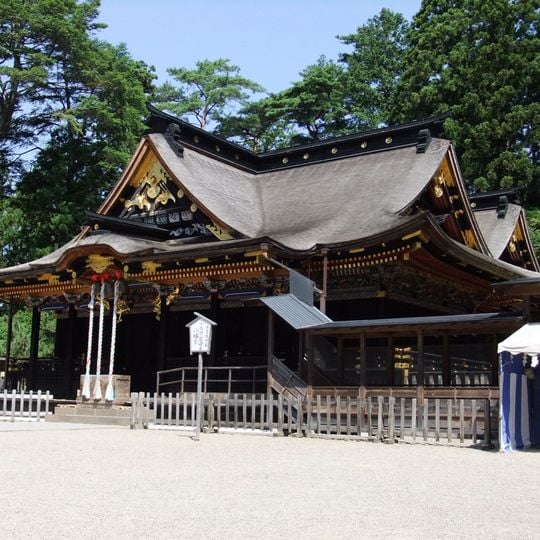
Ōsaki Hachimangū is a Shinto shrine in Aoba-ku, Sendai, whose main hall, stone chamber, and worship hall are a National Treasure of Japan. The worship hall has a seven-bay front, a gabled chidori-hafu over the entrance, and a karahafu porch, with black-lacquered pillars and colored carvings. A broad flight of shallow stone steps leads up to a pale grey stone torii gate.
The shrine's documented origin is a Hachiman shrine moved by the Ōsaki clan in 1527 to their territory in present-day Ōsaki, Miyagi. Date Masamune began building at the current site in 1604 and the main hall, stone chamber and worship hall were completed on 12 August 1607. The carpenters were Umemura Hikozaemon Ienaga and his son Sanjūrō Yoritsugu from Yamashiro, and Osakabe Saemon Kunitsugu from Kii.
The shrine is the guardian of people born in the Years of the Dog and Boar, a role tied to the zodiac-based Ketai Kami faith that flourished in Edo-period Sendai. Its Grand Festival on 14–15 September, held since 1609, features Noh kagura on the long hall and yabusame horseback archery. The 14 January Donto Festival burns New Year decorations, and men in white loincloths and headbands walk barefoot over the embers.
Buses from Sendai Station's west bus pool (stop 10 or 15) reach the Ōsaki Hachimangū-mae stop; the Loop Sendai bus from stop 16 takes about 43 minutes via other sights. The 98-step stone staircase narrows toward the top and can be slippery when wet. A free car park with about 70 spaces is near the north approach.
The shrine's stone torii, donated by the fourth Sendai lord Date Tsunamune in 1668, is the second-oldest in Sendai after that of Sendai Tōshōgū. It is a Myōjin-style gate about 5.7 m high, cut from granite quarried in Higashi-Iwai, Iwate. A storm-toppled tree damaged it in 1902; it was repaired in 1907.
The community of curious travelers
AroundUs brings together thousands of curated places, local tips, and hidden gems, enriched daily by 94,106 contributors worldwide.