Mount Hōō, Granite mountain peak in Yamanashi Prefecture, Japan
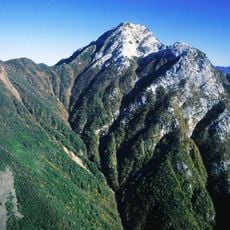
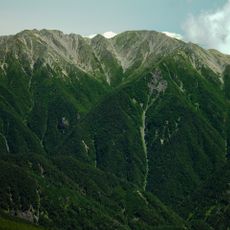
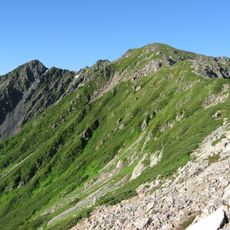
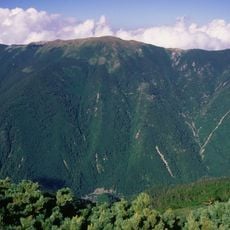
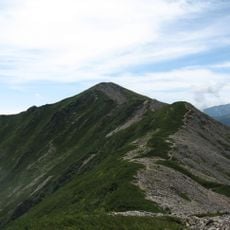
Mount Hōō is a granite massif in the Minami Alps National Park, Yamanashi Prefecture, made up of three peaks: Jizōdake, Kannon-dake and Yakushi-dake. Its highest summit, Kannon-dake, rises near the centre of a long ridge, with pale grey rock on top and dark green vegetation on the lower slopes. A steep gully cuts down the flank below the crest, and the massif stands above a deep valley.
Metal ore deposits on the mountain attracted mining operations during the Sengoku and Edo periods. These activities shaped the landscape and left marks that remain visible today.
The name Hōō-zan comes from the obelisk on Jizōdake, a granite spire likened to a bird's beak and thus to the phoenix (hōō). The three peaks are named Jizōdake, Kannon-dake and Yakushi-dake after Buddhist figures, and the saddle between Jizōdake and Akanukezawa-no-kashira, called Sainokawara, holds many stone Jizō statues. In 1990 Sumie Tanaka featured the mountain's alpine plants, including Takane-biranji and Hōō-shajin, in her book New Flowers of the 100 Mountains.
The Yashajin route from the east entrance of the Yashajin Tunnel is gentle and well maintained, but the standard time from trailhead to Mount Yakushi is seven hours. The Dondoko-zawa route from Aoki Kōsen is shorter and popular, passing the five-coloured, Shiraito, Hōō and Minami-Shōjin waterfalls. Camping is forbidden inside the national park except at designated sites, and huts close outside their operating season.
The mountain serves as the origin point for multiple river systems that flow through the surrounding regions. These waterways originate from the peaks and shape the landscape downstream.
The community of curious travelers
AroundUs brings together thousands of curated places, local tips, and hidden gems, enriched daily by 93,471 contributors worldwide.