Shinpu Castle, Japanese castle in Nirasaki, Japan
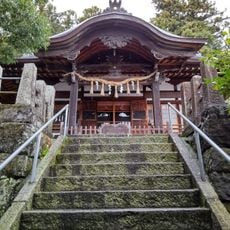
Shinpu Castle is a hirayama-style fortress on the Shiroyama plateau, a lava-flow tableland cut by the Kamanashi and Shio rivers in Nirasaki. Its earthworks, without stone walls, enclose about 500 by 200 metres: the inner bailey, second bailey, east and west third baileys and a belt enclosure, linked by dry moats, maru-umadashi and mikazuki-bori. The inner bailey now holds Takebu Inari Shrine.
Takeda Katsuyori began building Shinpu Castle in 1581 and moved there from Tsutsujigasaki Castle at the end of that year, though the castle and its town were still unfinished. In early 1582, after Kiso Yoshimasa defected, an Oda-Tokugawa army invaded Kai; Katsuyori set fire to the castle on 3 March 1582 and fled toward Iwadono Castle, where Oyamada Nobushige refused him entry.
The honmaru, the castle's innermost enclosure, now holds Fujitake Inari Shrine, a Shinto shrine, not a tomb or temple. The name Shinpu means "new capital", marking Katsuyori's move of the Takeda seat from Tsutsujigasaki Castle at Kofu. The site was designated a national historic site in 1973 and added to the Continued Top 100 Japanese Castles in 2017.
The ruins lie about a 10-minute walk from Shinpu Station on the JR East Chūō Main Line. The site is a hilltop of earthen ramparts and dry moats with uneven ground, so wear sturdy shoes; the shrine stands on the former inner bailey at the top.
The castle's north side was protected by two outworks that extended into a water moat, and the main gate was shielded by a half-circular earthwork with a dry moat. The whole circuit measured about 500 metres north to south and 200 metres east to west.
The community of curious travelers
AroundUs brings together thousands of curated places, local tips, and hidden gems, enriched daily by 94,714 contributors worldwide.