Mount Yoshino, Sacred mountain in Nara Prefecture, Japan
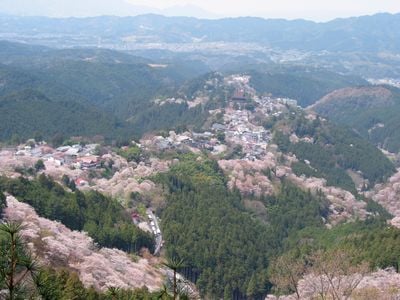
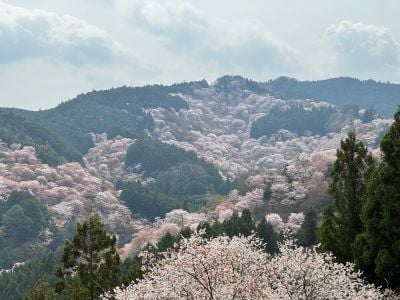
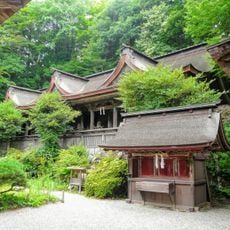
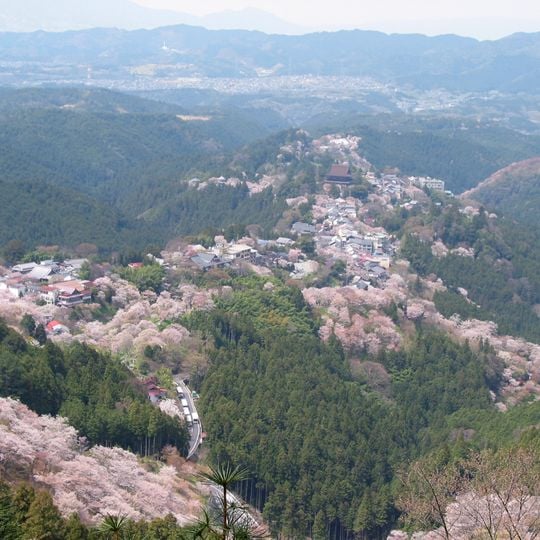
Mount Yoshino is a ridge about eight kilometres long running from the Yoshino River south to the Ōmine Mountains, with Kinpusen-ji at its centre. Its slopes are covered with some 30,000 cherry trees, mostly Shiroyamazakura, grouped into four groves called Shimo-senbon, Naka-senbon, Kami-senbon and Oku-senbon. A building with a large dark brown roof stands among the trees on the upper slope.
En no Gyōja, the 7th-century ascetic, is credited with founding the Ōmine Okugakemichi trail that links Kinpusen-ji here with the Kumano Sanzan shrines. In 1336 Emperor Go-Daigo fled Kyoto with the imperial regalia and set up a rival court on the mountain; he died here in 1339. In 1594 Toyotomi Hideyoshi held a cherry-blossom viewing party with about 5,000 people, using Yoshimizu Shrine as his headquarters.
Cherry trees here are regarded as the sacred tree of Zao Gongen, the central deity of Shugendo. Ascetics carved images of the deity from cherry wood, and worshippers donated cherry saplings as votive offerings, a practice that began in the Heian period. The mountain's name is also linked to Emperor Tenmu, who is said to have dreamed of cherry blossoms in midwinter at Yoshino before the Jinshin War.
The easiest way to reach the mountain is via the Kintetsu railway to Yoshino Station, then take the ropeway or walk uphill to reach Yoshinoyama town. The routes are clearly marked and take about 20 to 30 minutes depending on your pace.
The four groves are named Shimo-senbon, Naka-senbon, Kami-senbon and Oku-senbon, meaning lower, middle, upper and inner thousand trees. A 1714 account already described travellers passing a thousand trees at each stage of the climb. Most trees are Shiroyamazakura, a white-flowering wild cherry.
The community of curious travelers
AroundUs brings together thousands of curated places, local tips, and hidden gems, enriched daily by 94,085 contributors worldwide.