Hakusui Dam, Gravity dam in Taketa, Japan
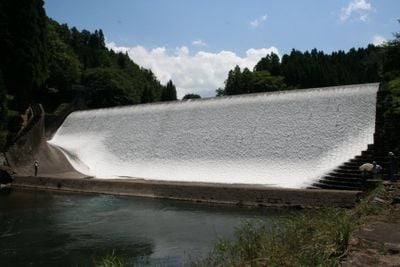
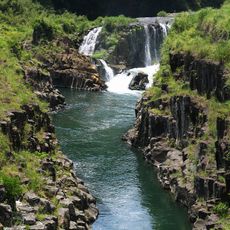
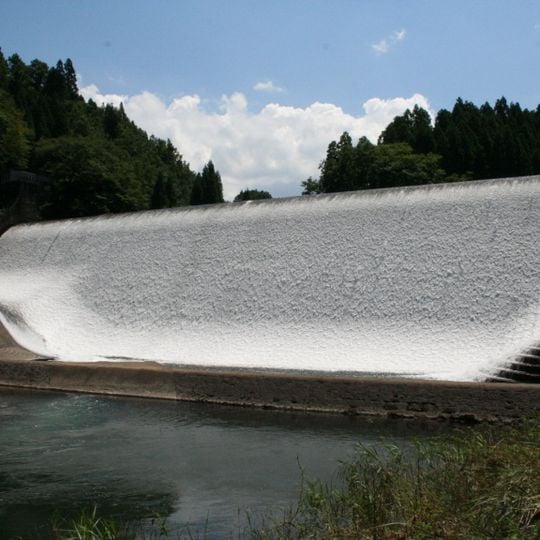
Hakusui Dam is a 14 m high, 86 m long concrete gravity dam on the upper Ōno River, its face clad in cut tuff stone. Water spills over the entire crest as a thin white veil, hiding the masonry. At the right bank a stepped channel turns the flow 90 degrees; at the left a curved chute does the same, both designed to slow water and protect the fragile volcanic ground.
Built between April 1934 and March 1938 to supply the Fuji-Oi irrigation canal, which carried water between Taketa and the Ogata district of Bungo-Ōno. The project was planned by the Fuji-Oi Irrigation Land Improvement Association and designed and supervised by Ōita agricultural engineer Yasuo Ono. It was designated an Important Cultural Property in 1999.
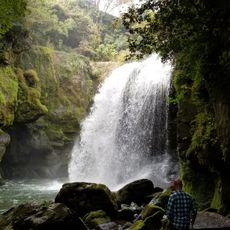
The name Hakusui, "white water", comes from the sheet of white foam seen when the Ōno River spills over the crest. Local farmers campaigned for the project through the Fuji-Oi Irrigation Land Improvement Association, and masons cut tuff from nearby quarries for the facing. The dam's image has appeared in a television advert for the shōchū brand Nikaidō.
The dam stands on the upper Ōno River in Taketa, Ōita Prefecture, reached by local roads through farmland. Water only flows over the crest when the river is high; in low water the spillway face stays dry, so time a visit accordingly. The stepped channel at the right bank and the curved channel at the left bank can be seen from the banks beside the structure.
The spillway turns the water 90 degrees: stepped blocks on the right bank, a curved chute on the left. Both side channels are meant to weaken the central flow and spare the fragile volcanic ground below the crest. Yasuo Ono's 123 construction photographs record the work from foundation to completion.
The community of curious travelers
AroundUs brings together thousands of curated places, local tips, and hidden gems, enriched daily by 93,680 contributors worldwide.