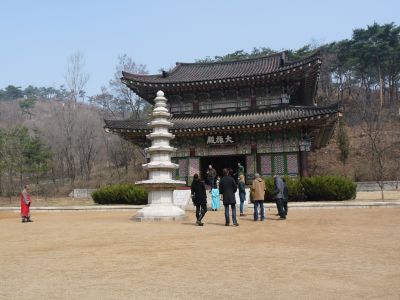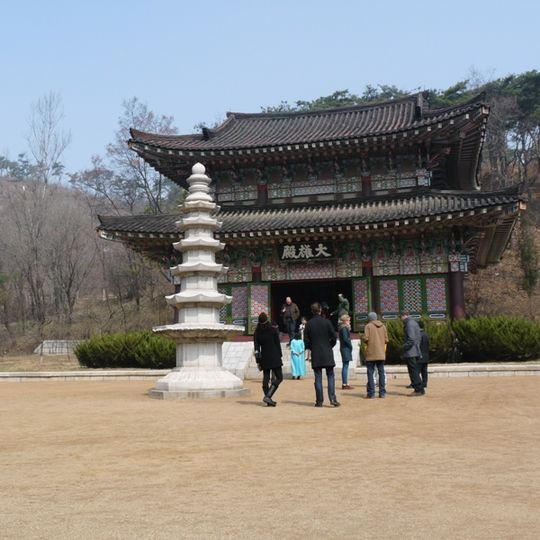
Kwangbŏpsa, Buddhist temple in Pyongyang, North Korea.
Kwangbŏpsa is a Buddhist temple in Pyongyang with a symmetrically arranged complex that includes the Haethal Gate, Chonwang Gate, Taeung Hall, east and west Buddhist monasteries, and an octagonal five-storied pagoda. The temple grounds contain a lotus pond, multiple halls for worship, and several monuments from 1727 that record the structure's history and past modifications.
The temple was founded in 392 by Gwanggaeto the Great during the Goguryeo kingdom and served as a religious center. Following a fire, it underwent major reconstruction in 1727, and after wartime damage the site was restored again in 1990.
The Haethal Gate displays carvings of young monks riding elephants and lions, while the Chonwang Gate shows images of four heavenly kings. These artworks reflect the religious symbolism that visitors encounter as they move through the temple grounds.
The temple grounds are easily navigable with clear pathways connecting the main buildings and the lotus pond. Visitors should allow time to walk the symmetrical layout and read the monuments to gain a deeper understanding of the site's development.
A local legend inscribed on a monument connects the temple to a tale of nine dragons and ninety-nine ponds at Mount Kuryong. This mythological account reveals the deep spiritual significance this place holds in local tradition.
The community of curious travelers
AroundUs brings together thousands of curated places, local tips, and hidden gems, enriched daily by 91,655 contributors worldwide.