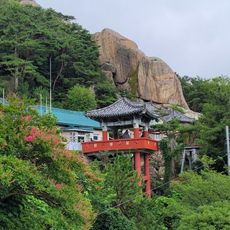
Tongdosa, Buddhist temple in Yangsan, South Korea
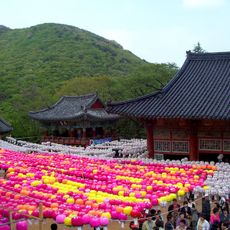
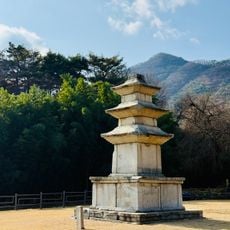
Tongdosa is a Buddhist temple at the foot of Yeongchwisan in Yangsan, South Gyeongsang. Its buildings follow a three-zone layout: the lower zone runs from Iljumun and Cheonwangmun to Bulimun and Daeungjeon, while side axes lead to halls such as Gwaneumjeon and Yeongsanjeon. Daeungjeon has a 3-by-5 bay single-storey frame with a roof ridge forming a 井 shape, and the Geumgang Gyedan altar stands behind it.
Jajang-yulsa founded Tongdosa in 646, during Queen Seondeok's reign, after returning from Tang China with relics of the Buddha. The temple thrived through Later Silla and Goryeo, and in the mid-15th century it is said to have had hundreds of buildings and thousands of monks. Only the Mahavira Hall survived the Japanese invasions of 1592–98; the other buildings were rebuilt afterwards.
Tongdosa is called the Buddha Jewel Temple because it enshrines Sari Jinsin, the Buddha's relics, in the Geumgang Gyedan behind Daeungjeon. The main hall has no Buddha image, only a large altar. The temple's name means 'Salvation of the World through Mastery of Truth', and its Beopdeung candle is said never to have gone out in over 1,300 years.
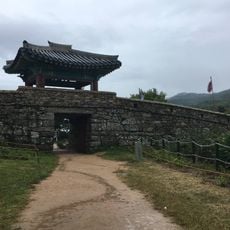
The temple lies on the southern slope of Mt. Chiseosan near Yangsan. From the entrance, the route passes the Three Arch Bridge, Iljumun, the Four Heavenly Kings Gate and Purimun before reaching Daeungjeon. The buildings are dispersed across the mountainside, so allow time for walking between halls.
The temple's name means "Salvation of the World through Mastery of Truth." Its Beopdeung, a temple candle, is said to have stayed lit without interruption for over 1,300 years since the temple's founding.
The community of curious travelers
AroundUs brings together thousands of curated places, local tips, and hidden gems, enriched daily by 93,764 contributors worldwide.