Gijang Japanese Castle, Military fortress in Gijang, South Korea
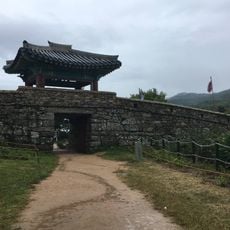
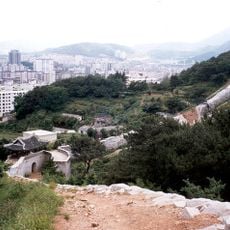
Gijang Japanese Castle is a fortress located on the coast with stone walls and wooden fortifications built in the 16th century. Defensive towers and traditional architectural elements are scattered across the terrain in different sections.
Kuroda Nagamasa built this stone fortress around June 1593, in the second year of the Imjin War, to defend against the Joseon army. It was designated a National Heritage Site in 1963, removed from the list in 1997, and re-designated as Busan Metropolitan City Monument No. 48 in 1999. Its stones originally came from the Dumopojinseong fortress.
The fortress is a Japanese-style stone wall built by Kuroda Nagamasa's forces, not a fusion of Korean and Japanese styles. Its stones came from the earlier Dumopojinseong fortress, and footstones of that structure still lie in rows around the villages of Dumopo. In Japan the site is called Gijang Castle.
The stone wall stands among farming fields and houses in Jukseong-ri, near the coast of Gijang. There is no direct public transport, so visitors usually arrive by car or taxi. The wall is about 4 metres high and the ground is uneven, so wear sturdy shoes. Excavations by the Bokcheon Museum in 2002 uncovered four baileys and parts of the wall.
The stone wall was built from stones taken from the earlier Dumopojinseong fortress, and rows of its footstones still lie around the villages of Dumopo. The wall stands about 4 metres high and once enclosed roughly 300 metres; the Korean source gives about 960 metres for the circuit.
The community of curious travelers
AroundUs brings together thousands of curated places, local tips, and hidden gems, enriched daily by 93,997 contributors worldwide.