Dongsam-dong Shell Midden, Archaeological site in Yeongdo District, South Korea
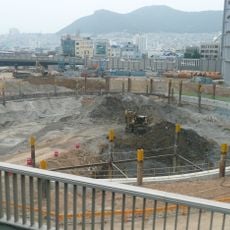
The Dongsam-dong Shell Midden is a Neolithic shell midden on a seaside slope in Dongsam-dong, Yeongdo District, Busan. Excavations revealed five stratified layers containing shells, animal bones, stone and bone tools, and three pottery types: plain, comb-patterned, and appliqué-patterned. The site also yielded the oldest known yunggwanmyo-style tomb in Korea.
Shells and debris accumulated at this location over thousands of years, with the earliest layers dating to around 8000 BC and extending to roughly 2000 BC. Excavations beginning in 1969 by the National Museum of Korea established this as one of the oldest Jeulmun period sites in the southern Korean peninsula.
The midden lies on a slope by the shore of Hari village in Dongsam-dong. Excavations found plain, comb-patterned and appliqué-patterned pottery, bone and stone tools, and whale and deer bones. A jar-coffin burial, the oldest of its kind in Korea, was first identified here.
The site is located on Yeong-do Island near the waterfront, accessible by local public transportation. Visitors should come prepared for an outdoor location and be aware that coastal conditions can change with the tide.
Excavations also uncovered a tomb in the yonggwan (jar-coffin) style, the oldest of its kind identified in Korea, which is important for the study of burial customs. Japanese comb-patterned pottery and stone tools made from Japanese obsidian found here point to exchange with Japan.
The community of curious travelers
AroundUs brings together thousands of curated places, local tips, and hidden gems, enriched daily by 93,519 contributors worldwide.