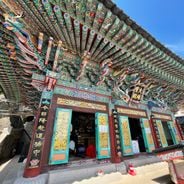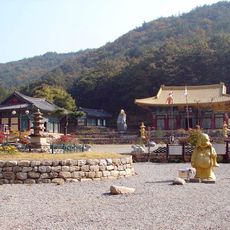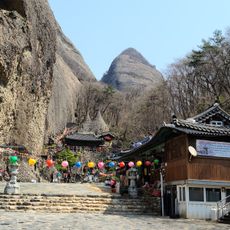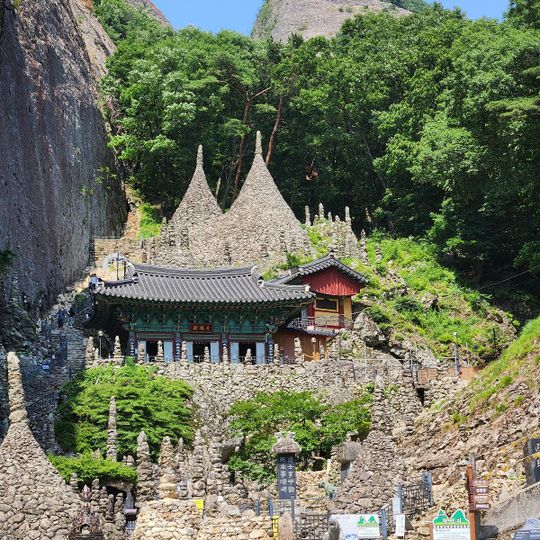
Tapsa, Korean Buddhist temple at Mount Mai, South Korea.
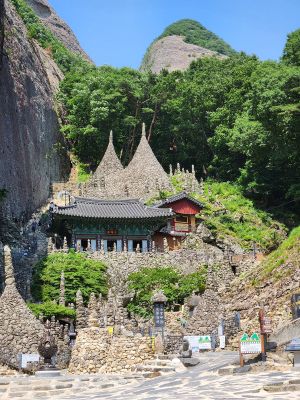
Tapsa is a temple located on the slopes of Mount Mai, where dozens of stone pagodas are assembled from natural stones without mortar. These pagodas vary in height and form, scattered across the temple grounds.
In 1885 the lay hermit Yi Gap Yong (1860–1957) came to Maisan at age 25 to meditate. Over the next 30 years he built up to 120 conical stone pagodas without mortar, single-handed. The site later became a Buddhist temple and Yi was ordained a monk. At least 80 of his pagodas remain.
The pagodas carry individual names such as Ohbangtap (Five Directions Pagoda), Yaksatap (God of Good Health), Walgwangtap (Moon Light) and Ilgwangtap (Sun Light). Yi Gap Yong laid the stones using the eight progressive positions of Zhuge Liang, and many larger pagodas were brought from streams and mountains across Korea for their spiritual energy.
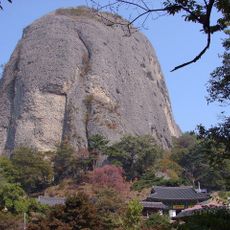
Tapsa sits within Maisan Provincial Park, south of the Maibong peak and below the cliff. The path through the park also passes Eunsusa and Geumdangsa temples, so the three are usually visited on one walk. The grounds hold at least 80 of Yi Gap Yong's pagodas, and the larger ones reach about 9 m, so allow time to walk among them.
The main pagodas have individual names: Ohbangtap (Five Directions), Yaksatap (God of Good Health), Walgwangtap (Moon Light), Ilgwangtap (Sun Light), Chungangtap (Center Rocking One) and Shinjangtap (God of Defense). Many smaller pagodas surround and protect them. Yi Gap Yong built the larger ones with stones carried from streams and mountains across Korea.
The community of curious travelers
AroundUs brings together thousands of curated places, local tips, and hidden gems, enriched daily by 93,464 contributors worldwide.