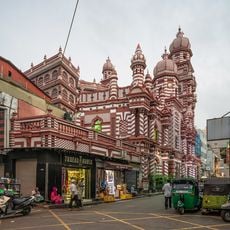
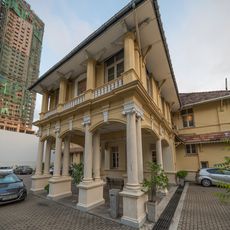
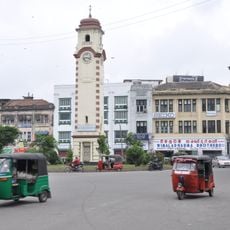
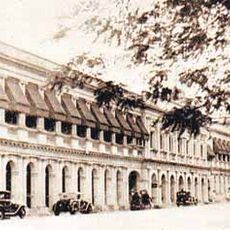
Colombo Grand Mosque, Islamic place of worship in central Colombo, Sri Lanka.
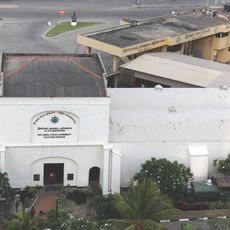
Colombo Grand Mosque is a two-story house of worship with white walls, geometric patterns, and several minarets that rise above the main prayer hall. Inside, the space is designed to accommodate many worshippers during the five daily prayers.
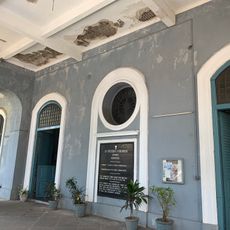
The mosque's history spans over 1,100 years: a 948 AD Arabic tombstone moved by the Dutch from the adjacent old Muslim cemetery suggests it may be Sri Lanka's oldest mosque. In 1520 King Bhuvanaikabahu of Kotte burned the town and two large mosques, but it was rebuilt on the same site. In the 1820s Malay architect Muhammad Balangkaya, exiled to Ceylon in 1790, rebuilt it as a two-storey structure; Governor Edward Barnes commended his work in 1826.
The mosque serves as a gathering place for the local Muslim community and anchors their presence in the city. It marks the center of religious and social life for worshippers who come here to pray and celebrate Islamic holidays.
Visitors can tour the building outside prayer times, though modest dress and removing shoes are expected. Plan your visit around the prayer schedule and use the marked entrances to show respect to worshippers.
The mosque holds the shrine of the Malay saint Bahu-Uddeen Tuan Bagoos Balankaya, remembered alongside the architect Muhammad Balangkaya, son of a Malay noble of the Royal House of Gowa exiled to Ceylon by the Dutch in 1790. An Arabic-inscribed tombstone dated 948 AD, moved by the Dutch from the old Muslim cemetery beside the mosque, was found in 1827 by Sir Alexander Johnston.
The community of curious travelers
AroundUs brings together thousands of curated places, local tips, and hidden gems, enriched daily by 93,509 contributors worldwide.