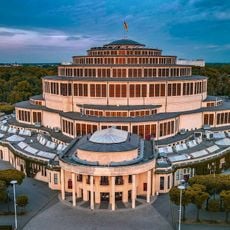
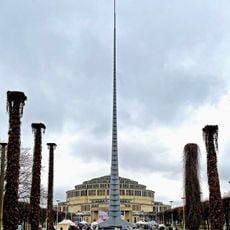
Organo della Sala del Centenario, Pipe organ in Centennial Hall, Wrocław, Poland.
The organ of the Centennial Hall in Wrocław was built in 1913 by Wilhelm Sauer of Frankfurt (Oder) and had 15,133 pipes in 185 stops, making it the largest organ in the world at its inauguration. It was played from a free-standing console with five manuals and electric action. After 1945 it was dismantled and divided among three new organs.
The organ was completed in 1913 during a period of cultural expansion in Wrocław. Its creation coincided with the inauguration of Centennial Hall marking the centennial commemoration of the Battle of Leipzig.
The organ's 1913 inauguration was marked by Max Reger's Introduktion, Passacaglia und Fuge e-moll op. 127, written for the city of Wrocław and premiered on 24 September 1913 by Karl Straube, to whom the work is dedicated. The instrument itself no longer exists in the hall: after 1945 it was dismantled into sections, and its registers went into three new organs, among them the Wrocław Cathedral organ.
The 1913 organ no longer exists in the hall: after 1945 it was removed and divided into three new instruments. One of them is the Wrocław Cathedral organ, today Poland's largest with 150 stops and 13,207 pipes; some stops went to the Jasna Góra basilica. A 1937 recording of the original instrument survives.
The organ was dismantled after 1945 and split into three new instruments. Its registers went partly to the Wrocław Cathedral organ, today Poland's largest with 150 stops and 13,207 pipes, and partly to the Basilica of Jasna Góra. A 1937 recording of the original organ survives.
The community of curious travelers
AroundUs brings together thousands of curated places, local tips, and hidden gems, enriched daily by 94,065 contributors worldwide.