Arsenal, Cultural heritage pavilion in Pushkin, Russia
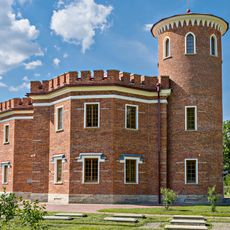
The Arsenal is a park pavilion in the Alexander Park of Tsarskoye Selo, built in 1819–1834 to designs by Adam Menelas and Alexander Ton. It takes the form of an English Gothic castle with Romanesque elements, crowned by crenellated towers. Inside, the first floor held a formal staircase, dining room, library and the Albanian Room, while the second floor has an octagonal Hall of Knights with a round table at its centre.
The site held Monbijou, a baroque hunting pavilion built in the mid-18th century by Francesco Rastrelli for Empress Elizabeth Petrovna. Adam Menelas began replacing it in 1819 with a Gothic-style arsenal; after his death in 1831, Alexander Ton completed it in 1834. Nicholas I moved his arms collection there that year.
The name Arsenal states the building's purpose: it held Nicholas I's collection of medieval, European and Oriental arms, begun while he was still a grand duke. In the entrance hall stood mannequins in armour, and the octagonal Hall of Knights on the upper floor displayed knightly armour on stuffed horses mounted on high pedestals. Since August 2016 the restored pavilion has housed the permanent exhibition "The Tsarskoye Selo Arsenal. The Imperial Arms Collection".
The pavilion stands in the centre of Alexander Park, a walk from the palace ensemble. The permanent exhibition opened in August 2016 after restoration begun in 2012. Inside, original 18th-century brickwork from the Monbijou pavilion is exposed in fragments; restored mouldings are painted white, while surviving ones are highlighted in dark colour.
After the 1885 transfer of the arms to the Hermitage, the Arsenal kept a collection of small equestrian models of officers and lower ranks, made by sculptor V. Hasenberger, showing the uniforms of Russian regiments under Nicholas I.
The community of curious travelers
AroundUs brings together thousands of curated places, local tips, and hidden gems, enriched daily by 93,650 contributors worldwide.