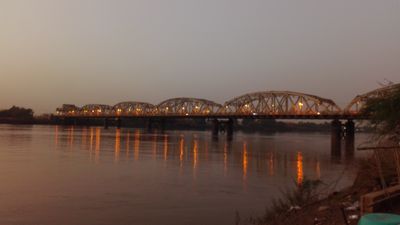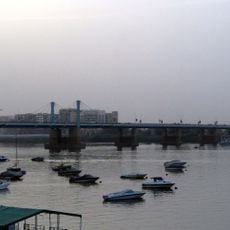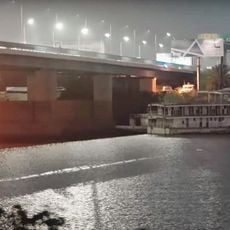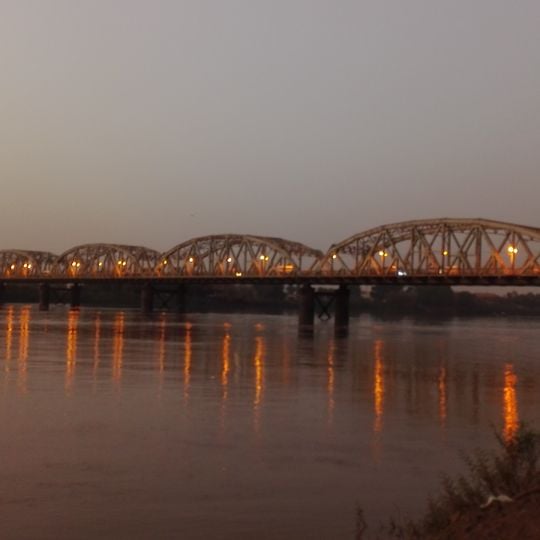
Blue Nile Road and Railway Bridge, Steel truss road and railway bridge over the Blue Nile in Khartoum, Sudan.
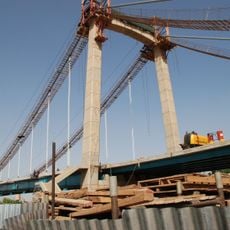
The Blue Nile Road and Railway Bridge is a steel and arch structure that carries traffic across the river, connecting the two urban areas on either side. The design accommodates both vehicular movement on one level and train traffic on another level.
Built between 1907 and 1909 by the Cleveland Bridge & Engineering Company to a design by engineer Georges Imbault, at a cost of 250,000 pounds sterling. It was one of the first infrastructure projects of the British colonial era meant to carry the railway across the Blue Nile, linking Khartoum station with Khartoum North (Bahri).
The bridge is known locally as Kubri al-Sika al-Hadid ("railway bridge"), Kubri al-Nil al-Azraq and Kubri al-Jami'a, the last because it stands beside the University of Khartoum, the country's oldest university. Its steel girders were shipped from Alexandria by rail to Khartoum North before assembly.
The deck carries two road lanes, one per direction, a railway line on the eastern side and a pedestrian walkway on the western side. The bascule span has not been opened for river traffic in a long time. The bridge was closed for maintenance in November 2017 and reopened in April 2018.
The bridge is a bascule bridge: its deck could be opened to let river vessels pass beneath. It was opened and closed regularly in the past but has not been opened for a long time. It is a steel truss (girder) bridge under Sudan Railways.
The community of curious travelers
AroundUs brings together thousands of curated places, local tips, and hidden gems, enriched daily by 93,366 contributors worldwide.