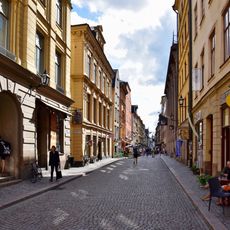
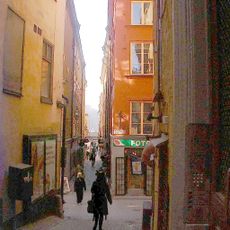
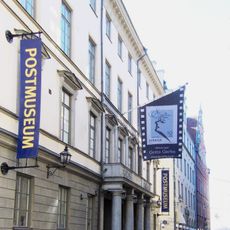
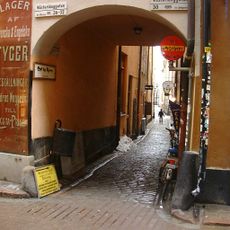
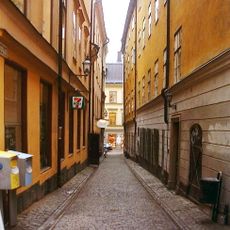
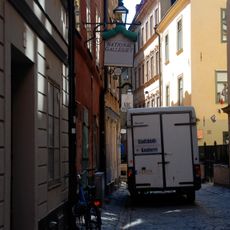
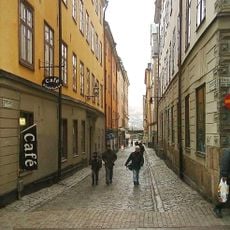
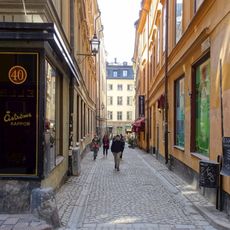
Tyska brinken, Pedestrian street in Gamla Stan, Stockholm, Sweden.
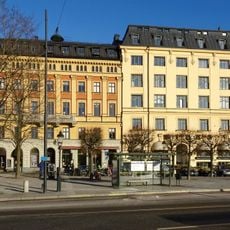
Tyska Brinken is a street in Gamla Stan that runs from where Kindstugatan ends, by the German Church, down a steep slope to Mälartorget. It is crossed by Skomakargatan, Prästgatan, Västerlånggatan, Stora Nygatan, Lilla Nygatan and Munkbrogatan. The Rococo building at numbers 20–22 was formed in 1869 by merging three medieval properties, and blind windows mark the joins.
The street was recorded as Vattubrinken in 1454 and later as Skomakarbrinken. It appears as Tyske Kyrkebrinken in 1612 and Tyska brinken in 1679; the western section was called Jochum Bryggares gränd around 1700 after the German-born master brewer Jochum Ahlstedt (died 1680). The name Tyska Brinken was formalized in 1880, when that western section was also incorporated into the street.
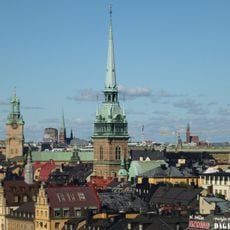
The name comes from the German Church and parish: in the Middle Ages half of Stockholm's population and city council were German, and the wealthiest burghers were German. German merchants gathered at the Guild of St Gertrud on the church's present site. King John III sanctioned a German parish and graveyard in 1571, and the Germans completed the present church in 1638–1642.
The street climbs noticeably from Mälartorget up to the German Church, so the upper stretch is steep. It runs from where Kindstugatan ends down to the square, and the first numbers on the eastern end start at 20 because it continues Kindstugatan's numbering. It is crossed by Skomakargatan, Prästgatan, Västerlånggatan, Stora Nygatan, Lilla Nygatan and Munkbrogatan.
Archaeological digs at the corner of Lilla Nygatan and Tyska Brinken in 1993 exposed an old city wall and what was first read as the 14th-century Bocktornet, the "Buck Tower". Later study suggests the remains belong instead to defences built in the 1560s.
The community of curious travelers
AroundUs brings together thousands of curated places, local tips, and hidden gems, enriched daily by 93,483 contributors worldwide.