The Palm House, Victorian botanical conservatory in Trädgårdsföreningen, Sweden
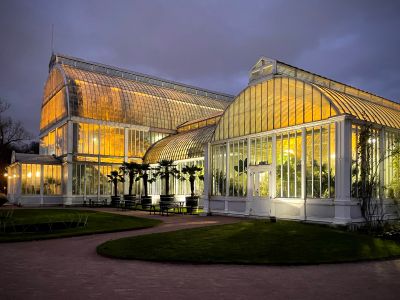
The Palm House is a Victorian glasshouse in Trädgårdsföreningen with multiple climate-controlled sections housing tropical plants, desert flora, Mediterranean species, and an orchid collection beneath a glass dome. The building features extensive glass walls and metal frameworks that divide the botanical spaces and create an experience of traveling through different climate zones.
The Palm House was completed in autumn 1878, designed by Alexander Shanks & Son in Arbroath, Scotland, modelled on London's Crystal Palace. It cost 165,000 kronor, financed by public bond loans, and was first called the New Winter Garden. After subsidence damaged its cast-iron frame, it was restored in 1980–85 for about 17 million kronor, a third paid by the National Heritage Board.
The Palm House was first called the New Winter Garden when it opened in 1878, and despite a high entrance fee it became popular with Gothenburg residents. The building was ordered from Scotland and designed by Alexander Shanks & Son in Arbroath, with the Crystal Palace in London as its model. The construction was financed by bond loans from the public.
The Palm House has five connected sections, each with its own climate: the central hall with palms, Tropikhuset and Vattenhuset to the east, Medelhavshuset and Kameliahuset to the west. The entrance pavilion on the central hall's front was added in 1890. The building is a listed monument, so some original cast-iron details remain visible.
The central hall reaches 14.5 metres at its highest point, and the whole glasshouse covers about 925 square metres. Look up: the roof and lantern are carried by arched cast-iron beams whose thrust is taken by columns around the perimeter, leaving the great nave free of supports.
The community of curious travelers
AroundUs brings together thousands of curated places, local tips, and hidden gems, enriched daily by 93,566 contributors worldwide.