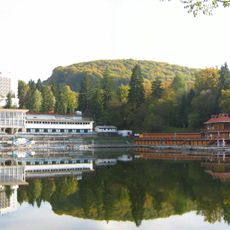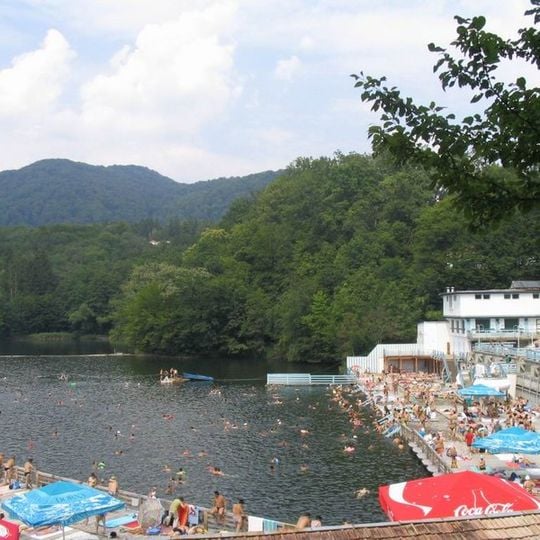
Lake Ursu, Salt lake nature reserve in Sovata, Romania.
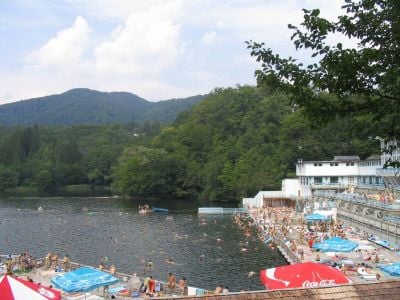
Lake Ursu is a heliothermal salt lake in Sovata, Mureș County, formed in 1875 when a salt mine collapsed and filled with stream water. Its surface salinity is about 100 g/l, rising to 220–300 g/l at depth. A wooden walkway extends over the water near a concrete and stone terrace, beside a white multi-story building with rows of windows and a flat roof.
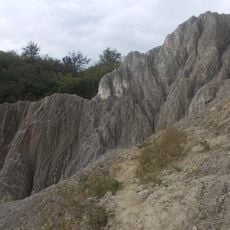
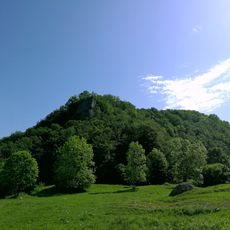
The lake appeared on 27 May 1875, when a downpour flooded the former Pálné gödre salt karst depression beside Sovata. Its present shape was reached by 1881 as the basin shifted and silted up. In 2000 the lake and its salt-tolerant woods became a 79-hectare mixed nature reserve.
The lake was first called Illyés-tó after Lajos Sófalvi Illyés, the landowner who founded Felső-Szováta in 1900; a 1902 spa guide still wrote "Illyés-féle Medve-tó". The name Medve-tó spread after 1910, from the lake's outline resembling a stretched bearskin. A legend tells of a fairy's unrequited love for a shepherd boy.
Swimming sessions are limited to maintain the lake's natural heat and water quality for all visitors. It is best to plan your visit in advance and check local conditions before arriving.
The lake's fresh surface layer, lighter than the salt water beneath, traps solar heat; at 2 metres the water reaches 35 °C, and 80 °C was measured in its warmest layer when it formed in 1875. Bathers mix the layers, so entry is banned for one hour at noon to let the fresh layer re-form.
The community of curious travelers
AroundUs brings together thousands of curated places, local tips, and hidden gems, enriched daily by 94,737 contributors worldwide.