Turnul Colței, Demolished bell tower site in Bucharest, Romania
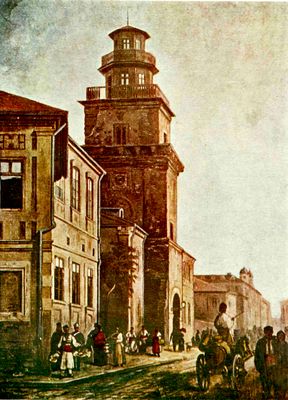
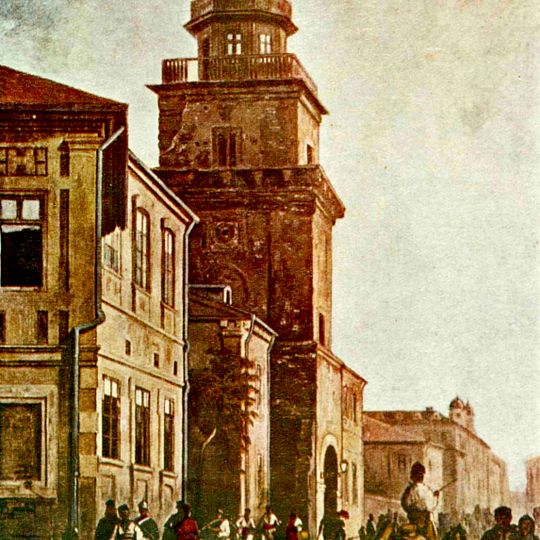
Turnul Colței was a 50–54 m bell tower built 1709–1714, with a double-H plan covering 100 m², stone-and-river-boulder foundations, brick walls, and a baroque roof with four corner turrets. Its carved stone balustrade alternated the Cantacuzine eagle, floral ornaments, and a vase of flowers, supported by corbels ending in lion heads.
Built between 1709 and 1714 as the bell tower of the Colțea Monastery, the tower was partly raised by Swedish soldiers who had fled to Wallachia after the Battle of Poltava and were hosted by Constantin Brâncoveanu. Spătar Mihai Cantacuzino kept his secret archive inside it. The 1802 earthquake destroyed its upper part and clock; the upper floors were rebuilt in wood and it served as a watchtower until its demolition in 1888.
The tower served as a spiritual landmark for the surrounding community through its bells and functioned as a visible symbol of the monastery's presence in the city. Its sounds would have marked daily rhythms and religious occasions for residents of this quarter.
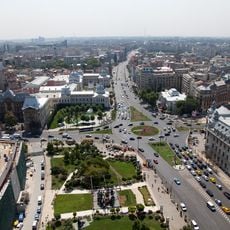
The tower no longer stands: it was demolished in August 1888, and its stone foundations lie beneath the roadway of today's Bulevardul I. C. Brătianu. For a time, white stones marked their outline in front of the Suțu Palace, but asphalt works covered them. Two corbels from the tower's carved balustrade are kept in the small lapidarium beside Stavropoleos Church.
The tower's 1,700 kg bell fell during the 1802 earthquake, striking a vendor in the entrance passage. It was later moved to Sinaia Monastery and installed in the bell tower built in 1892 on the south side of the enclosure. The tower's foundations still lie under the asphalt of today's Bulevardul I. C. Brătianu.
The community of curious travelers
AroundUs brings together thousands of curated places, local tips, and hidden gems, enriched daily by 94,019 contributors worldwide.