Đavolja Varoš, Natural monument in Radan Mountain, Serbia
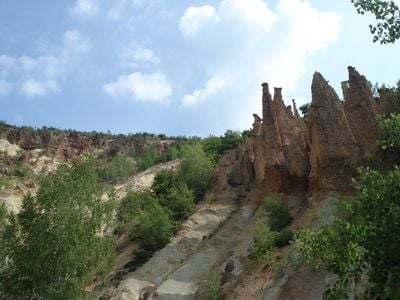
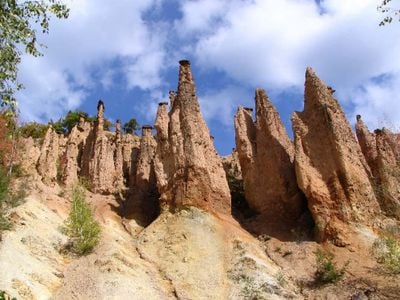
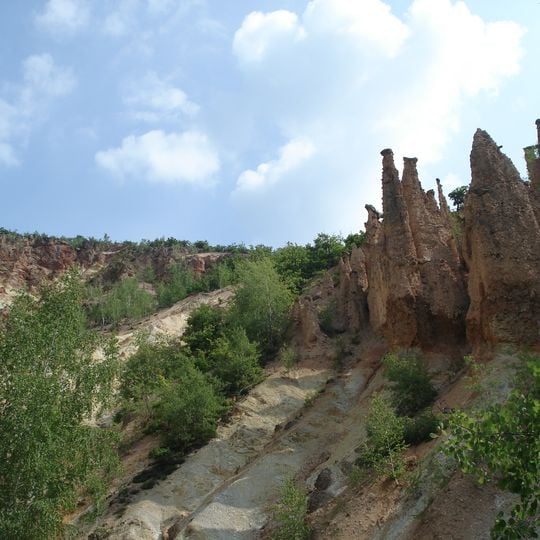
Đavolja Varoš consists of 202 earth pillars, 2 to 15 m tall and 0.5 to 3 m wide, set in two gullies, Đavolja jaruga and Paklena jaruga, on the slopes of Radan Mountain. Each pillar is topped by a block or cup of andesite that shields the softer earth beneath. The pillars are bare, grooved, and capped by darker crusts.
Scientific study of the formations began in 1955 by Tomislav Rakićević and led to their protection as a state site in 1959. Recognition as a protected area was based on findings from these early geological investigations.
The name means "Devil's Town" in Serbian. One legend tells of a wedding party of 200 turned to stone at noon by a flash brighter than the sun, after a brother and sister fell in love under a spell from the Devil's Water spring. Visitors leave rocks in place, as taking one is said to turn the taker to stone.
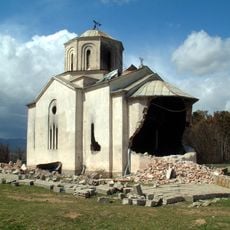
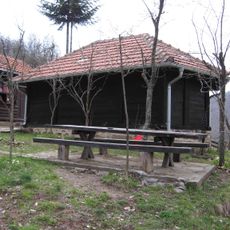
The site is easily accessible and offers basic facilities including two restaurants near the entrance and a wooden chapel. Visitors should bring walking shoes and allow enough time to explore the formations from different viewpoints.
The two springs are not ordinary mineral waters: Đavolja voda has a pH of 1.5 and 15 g/L of dissolved minerals, while Crveno vrelo reaches pH 3.5 with 4.372 mg/L. Aleksandar Zega, founder of the Serbian Chemical Society, first examined them in 1905. Scientists warn that Đavolja voda should not be drunk because its iron, copper and sulphur levels are extremely high.
The community of curious travelers
AroundUs brings together thousands of curated places, local tips, and hidden gems, enriched daily by 93,226 contributors worldwide.