Alexandria Park, Imperial park in Petergof, Russia
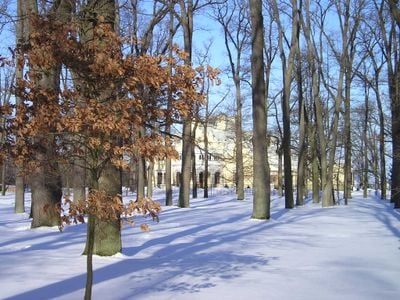
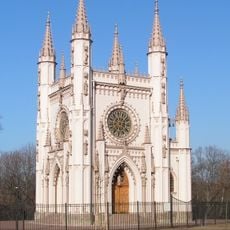
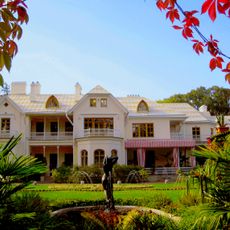
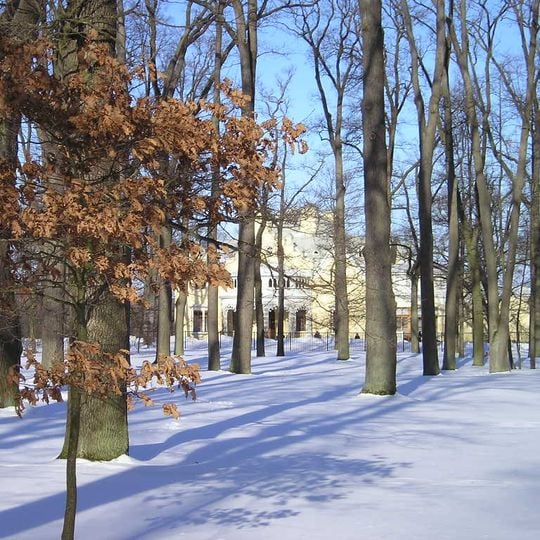
Alexandria Park is a 115-hectare palace and park ensemble east of Peterhof's Lower Park, separated from it by a stone wall pierced by the Animal, Nicholas and Sea gates. Its grounds stretch on two terraces between the St Petersburg–Oranienbaum highway and the Gulf of Finland. The main buildings — the Cottage, the Farmer's Palace and the Gothic Chapel — stand on the upper terrace.
The land passed through several owners before Empress Anna acquired it in 1733 and created the Jagdgarten hunting park, with a wooden pavilion from which she shot driven game. By the 1770s it had declined into the Oleny Zverinets deer enclosure. Nicholas I gave the estate to his wife Alexandra Feodorovna in 1825, and from 1826 Adam Menelas built the Cottage and laid out the park, completed by 1829.
The park's name honours Empress Alexandra Feodorovna, wife of Nicholas I, who received the estate in 1825. Its heraldic emblem, devised by poet Vasily Zhukovsky, shows a bare sword passed through a wreath of white roses and appeared on nearly every building in Alexandria. The Gothic Chapel served as the imperial family's private summer church, dedicated to Alexander Nevsky.
Alexandria Park lies east of the Lower Park of Peterhof, from which a stone wall separates it; three gates cut through the wall, including the Animal, Nicholas and Sea gates. The 115-hectare grounds run from the St. Petersburg–Oranienbaum highway in the south to the Gulf of Finland in the north, on two terraces. The Cottage is open to visitors; the Farmer's Palace reopened in 2010 and the Gothic Chapel in 2006.
The park's coat of arms, devised by poet Vasily Zhukovsky, shows a naked sword threaded through a wreath of white roses and appeared on nearly all its buildings. The Cottage was restored by 1978 under architect I. N. Benois, and the Gothic Chapel reopened in June 2006 after restoration.
The community of curious travelers
AroundUs brings together thousands of curated places, local tips, and hidden gems, enriched daily by 94,550 contributors worldwide.