See the monuments around you in AROpen chests in the app
Around Us is built for your phone — point your camera at the streets and discover the monuments and places around you in augmented reality.Around Us is built for your phone — chests unlock when you walk, explore and capture nearby places.
The Turkish Mediterranean reveals its layers of history, from Greek and Roman remains to medieval fortresses, dotted with geological phenomena that defy time.
The Turkish Mediterranean coast tells the story of millennia. You will find the ruins of Greco-Roman cities, temples and ancient theaters that still stand above the sea, next to medieval fortresses and small villages where time seems to have stopped. Regions like Lycia and Phrygia have left their traces everywhere: in the facades of houses, in the walls of fortresses, in the objects kept in museums.
This region combines two worlds. On the coast, you find beaches, active ports, and towns with a certain gentleness. Heading inland, the landscape changes: mountains appear, canyons with turquoise water open up, crystal-clear lakes shine in the valleys. Astonishing natural phenomena complete the picture: flames coming out of the mountain, waterfalls plunging into the sea, caves filled with limestone formations.
This collection brings together 30 destinations that show every side of this region. You can walk among the columns of a Roman temple in the morning, swim in clear water in the afternoon, and have dinner in a small whitewashed town in the evening. Some sites are well known, others are less visited. All offer something special: a trace of the past, natural beauty, or both at once.
The Turkish Mediterranean reveals its layers of history, from Greek and Roman remains to medieval fortresses, dotted with geological phenomena that defy time.
The Turkish Mediterranean coast tells the story of millennia. You will find the ruins of Greco-Roman cities, temples and ancient theaters that still stand above the sea, next to medieval fortresses and small villages where time seems to have stopped. Regions like Lycia and Phrygia have left their traces everywhere: in the facades of houses, in the walls of fortresses, in the objects kept in museums.
This region combines two worlds. On the coast, you find beaches, active ports, and towns with a certain gentleness. Heading inland, the landscape changes: mountains appear, canyons with turquoise water open up, crystal-clear lakes shine in the valleys. Astonishing natural phenomena complete the picture: flames coming out of the mountain, waterfalls plunging into the sea, caves filled with limestone formations.
This collection brings together 30 destinations that show every side of this region. You can walk among the columns of a Roman temple in the morning, swim in clear water in the afternoon, and have dinner in a small whitewashed town in the evening. Some sites are well known, others are less visited. All offer something special: a trace of the past, natural beauty, or both at once.
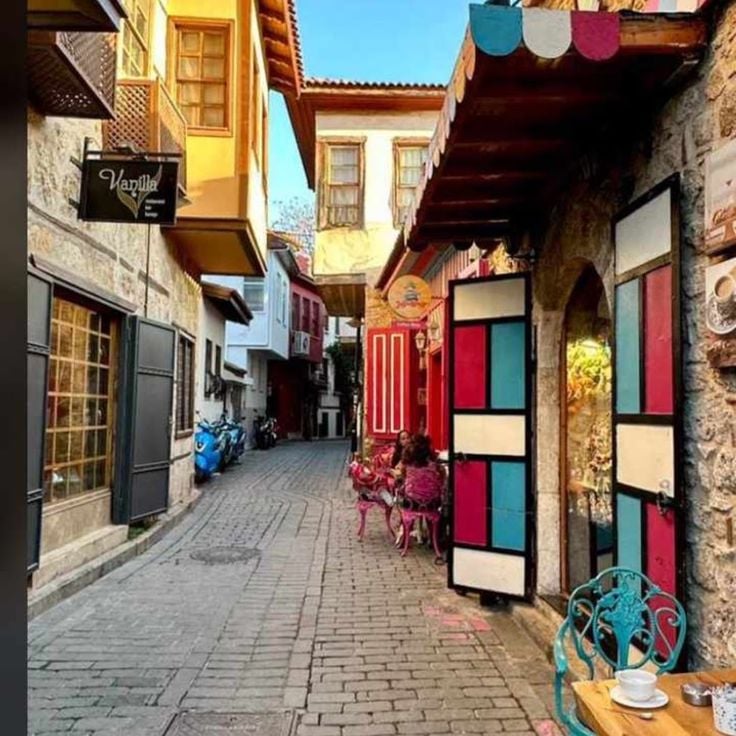
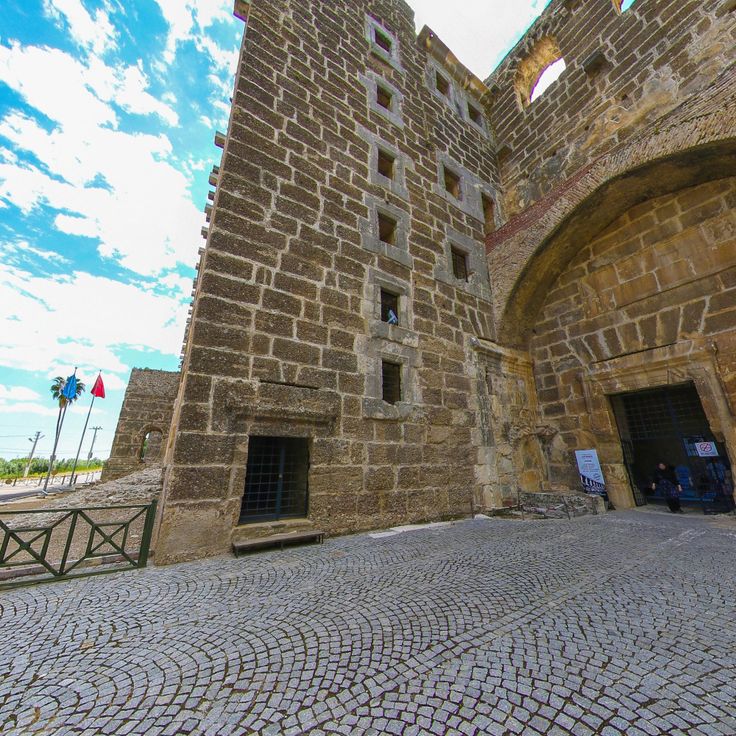
The old city of Antalya, known as Kaleiçi, sits just behind the ancient harbor. Narrow cobblestone streets run past Ottoman wooden houses with overhanging balconies. At nearly every turn, traces of different eras appear: Byzantine walls, a Roman tower, a medieval mosque. The Gate of Hadrian, built nearly 2,000 years ago, still stands at the old entrance to the city. Below, the small harbor is tucked between rocks and dotted with boats. Locals and visitors move through the same streets without any clear divide.
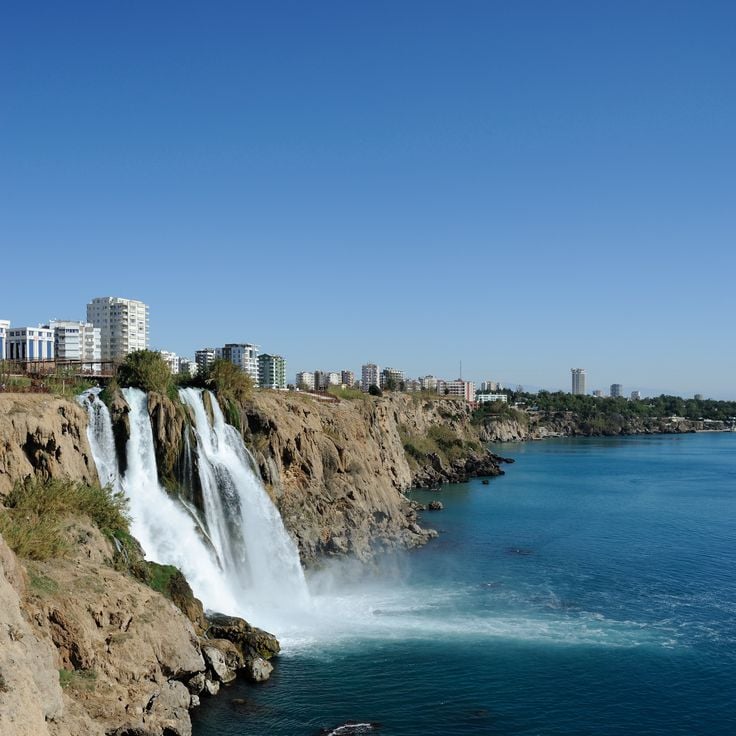
The Düden Waterfalls sit on the cliffs at the edge of Antalya and drop straight into the Mediterranean Sea. Fresh water meets salt water at the base of the falls, where the spray rises back up along the rocky face. You can watch from the clifftop path above, or take a boat to see the falls from the sea. The sound carries far, and the mist reaches you before you even see the water falling.
The ancient theater of Aspendos, near Antalya, is one of the best-preserved Roman theaters anywhere. Built in the 2nd century, it could seat around 15,000 people. The stone seating, the stage, and the tall backdrop wall are nearly intact. Walking in, you get a real sense of how a Roman crowd would have gathered here. In summer, concerts and performances are still held on the original stage.
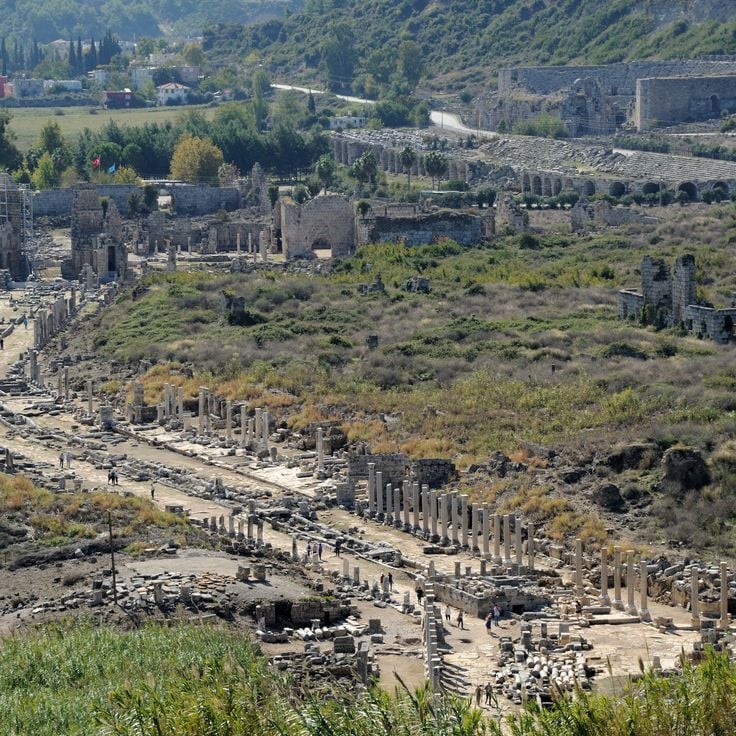
The ancient city of Perge sits a short drive from Antalya and stands as one of the most complete Greco-Roman cities on the Turkish Mediterranean coast. Walking through the main gate, a wide colonnaded avenue opens up ahead, flanked by the ruins of baths, a market, a theater, and a stadium. The stones are well laid out, and the scale of the city gives a real sense of how large and active it once was.
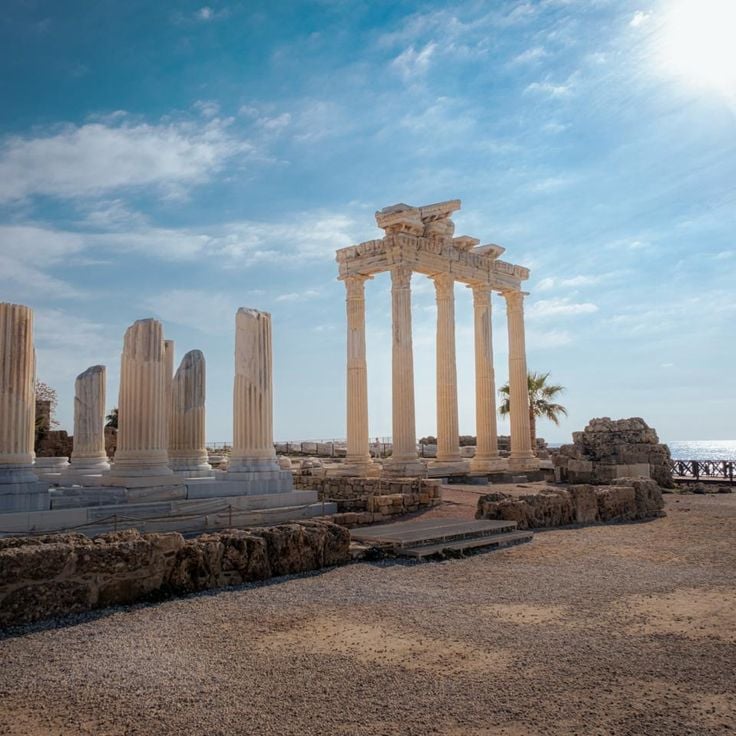
Side is an ancient city on the Turkish Mediterranean coast where the remains of a Greek and Roman past are still standing in the middle of a lived-in town. The temple of Apollo sits right at the water's edge, its columns silhouetted against the sea. Around it, an old theater, stone streets, and city walls tell the story of a place that was once a major port. Today, people walk through these ruins as part of everyday life.
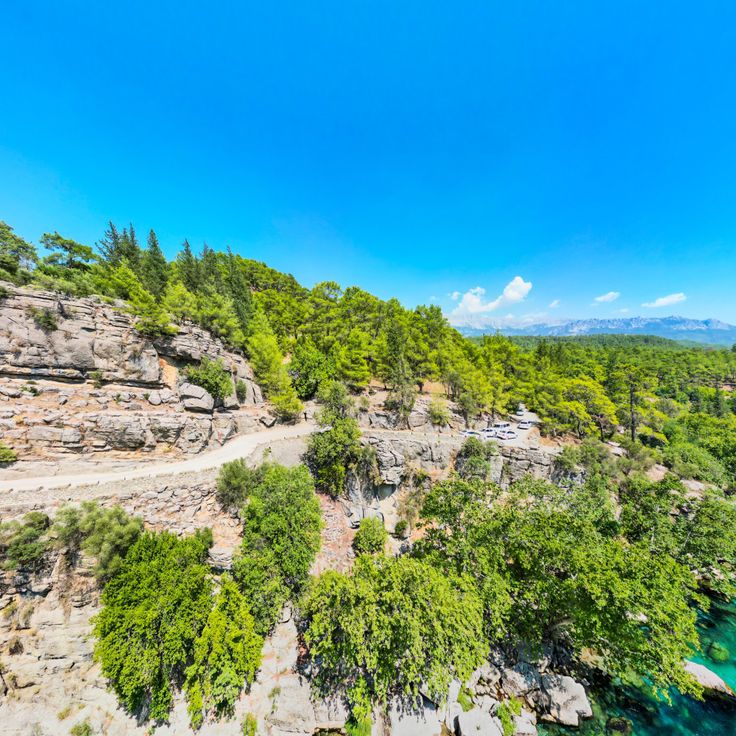
Köprülü Canyon National Park sits in the mountains behind the Antalya coast. The Köprüçay River runs through it, carving a deep gorge into the rock and flowing in a clear turquoise color. The canyon draws many visitors for rafting trips on the fast-moving water. Two old Roman bridges still cross the river at narrow points, and they have stood in place for nearly 2,000 years. Hiking trails run along the canyon walls through pine forest. The park feels far removed from the coast, even though the sea is only a short drive away.
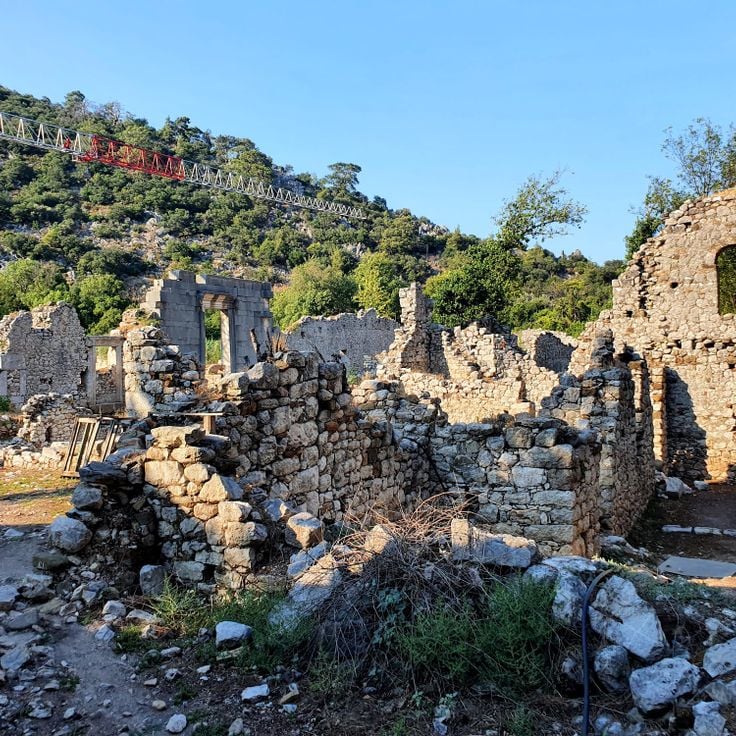
Olympos, this ancient Lycian city, welcomes you with its ruins scattered across a wooded valley that gently slopes down to a long sandy beach. As you walk the path, you pass by wall remnants, discover sarcophagi, and catch sight of temple fragments half-buried under vegetation. As you progress, the Mediterranean gradually reveals itself. What strikes you here is the closeness between two worlds: just a few minutes' walk separate the stones of the past from the shore where the waves break.
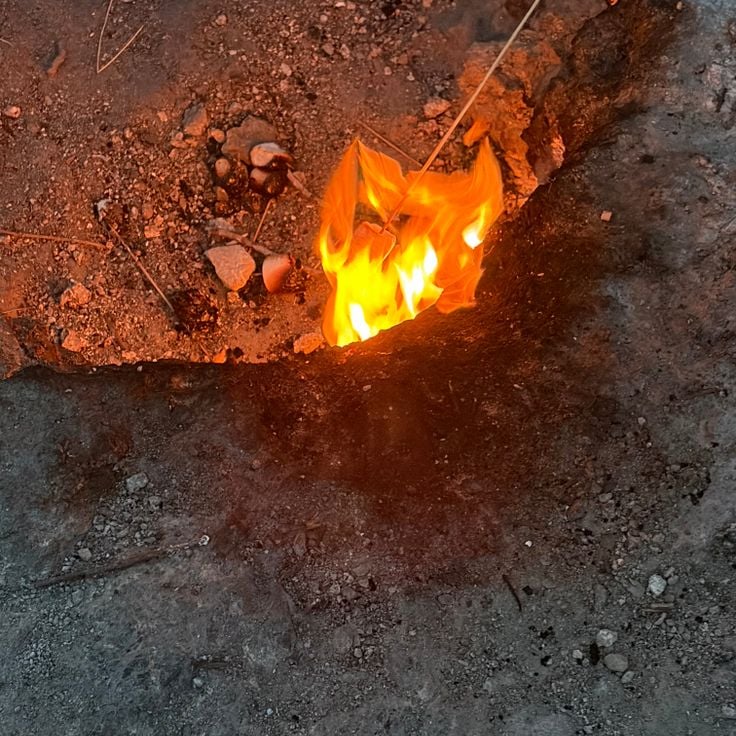
The Chimaera of Yanartaş is a hillside on Mount Olimpos where flames rise straight out of the rock. The gas feeding these flames has been seeping through the ground for centuries, burning without interruption. The ancient Greeks placed here the fire-breathing monster described by Homer. Today, you can climb up at night and watch the flames glow in the dark, surrounded by pine trees and old ruins.
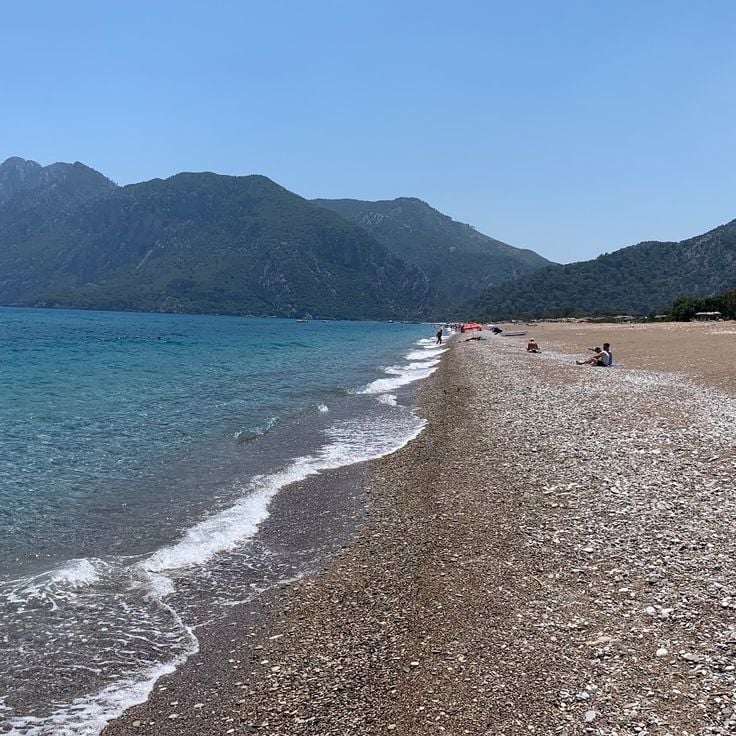
The beach of Çıralı sits at the foot of a forested mountain, where pine trees come down almost to the water. Behind the beach, a small village stretches along a dirt road: no large hotels, no loud music, just simple guesthouses and restaurants shaded by trees. The beach is long, covered with fine gravel, and the water is clear. At night, sea turtles come ashore to lay their eggs, which makes this stretch of coast one of the few in Turkey where nature still sets the pace.
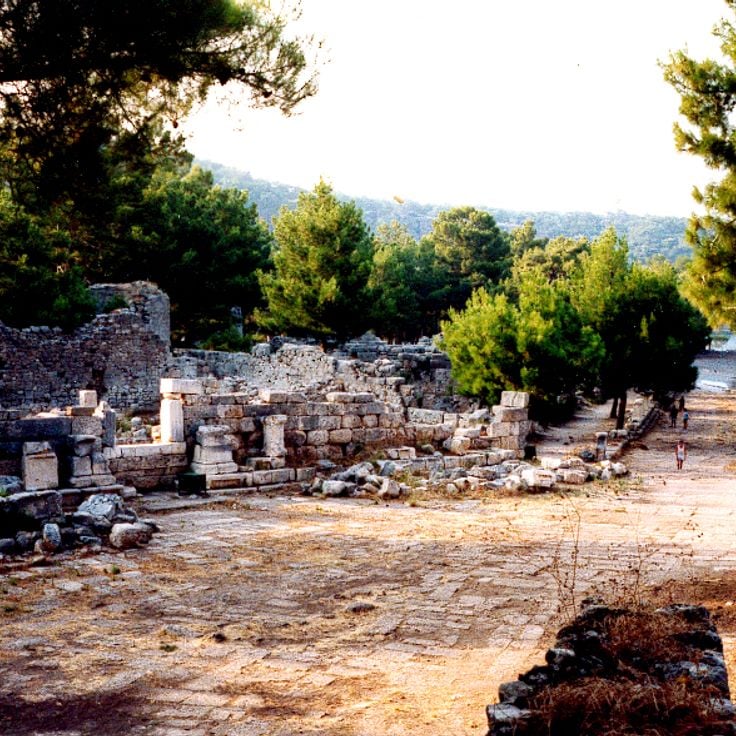
Phaselis sits on a wooded peninsula along the Turkish Mediterranean coast, where the remains of a Greek and Roman city meet the sea. The site once had three harbors, and you can still walk along the old colonnaded main street, pass the ruins of a theater, and reach small sandy coves within a few minutes. Pine trees grow between the ancient stones. It is a place where you can explore ruins in the morning and swim in calm water by noon.
Kekova is a small island off the Mediterranean coast of Turkey, where the remains of an ancient city lie just beneath the surface of the water. From a boat, you can see submerged walls, steps, and foundations through the shallow water without diving. Earthquakes in antiquity pulled this city into the sea. Today, small boats drift slowly over the ruins, while the village of Üçağız and Lycian rock tombs carved into the cliffs are visible along the shore nearby.
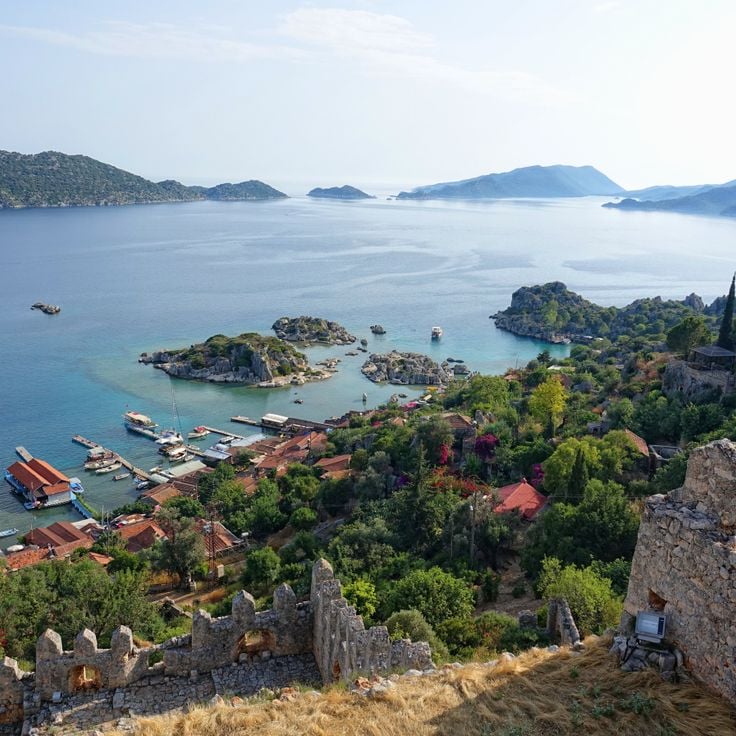
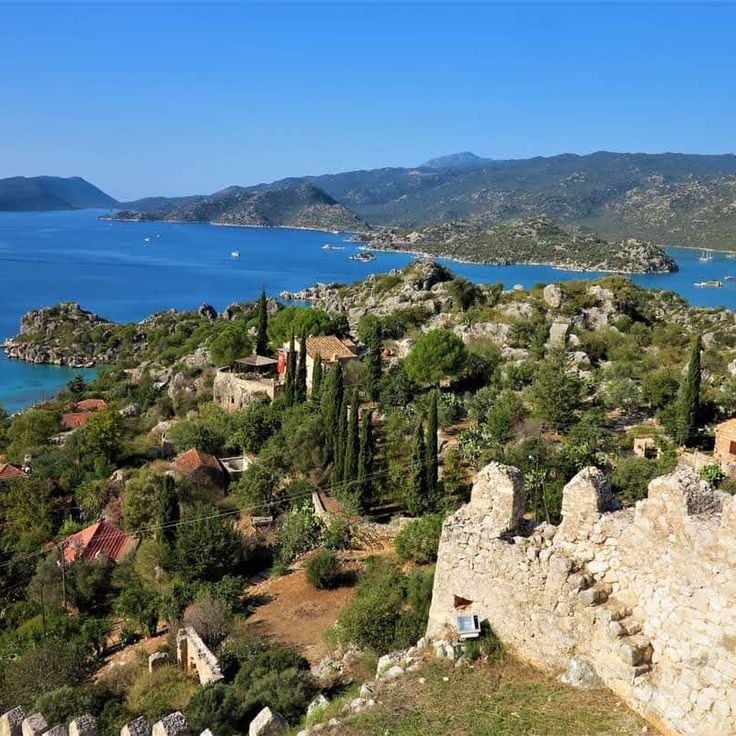
Kaleköy, the ancient Simena, can only be reached by boat or on foot. The village sits at the edge of the sea, with a medieval fortress rising above its rooftops and Lycian rock tombs carved into the hillside all around. The houses are close together, the lanes are steep and narrow, and the water below is clear enough to see the bottom. There are no roads for cars, which gives the place a pace of life that feels rare along this stretch of the Turkish Mediterranean coast.
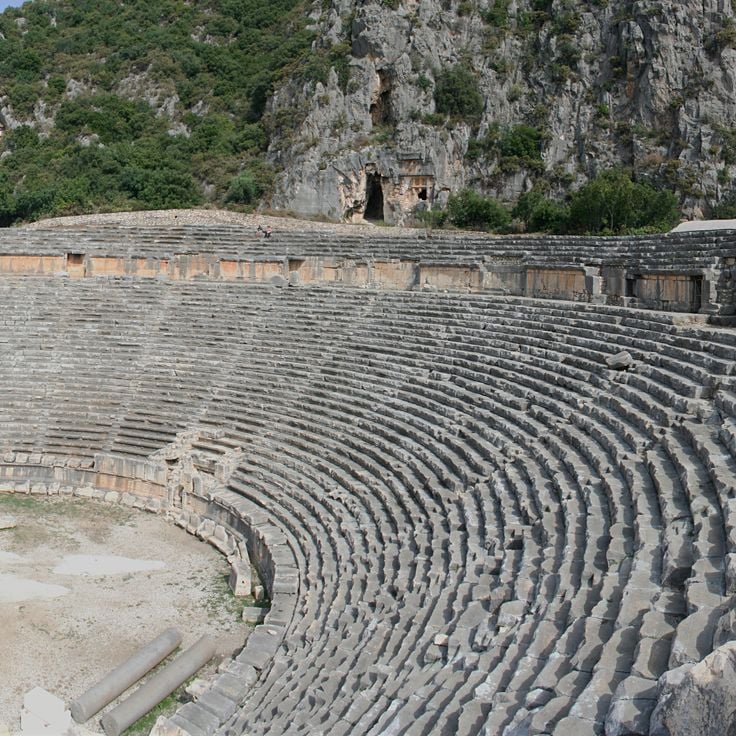
Myra, an ancient city near present-day Demre, is one of the best-known Lycian sites along the Turkish Mediterranean coast. Its rock-cut tombs are carved directly into the cliff face, stacked on top of one another like the floors of a building. Their facades imitate the doors and windows of old Lycian wooden houses. Below the cliff stands the ancient theater, still largely intact, giving a clear sense of how large this city once was.
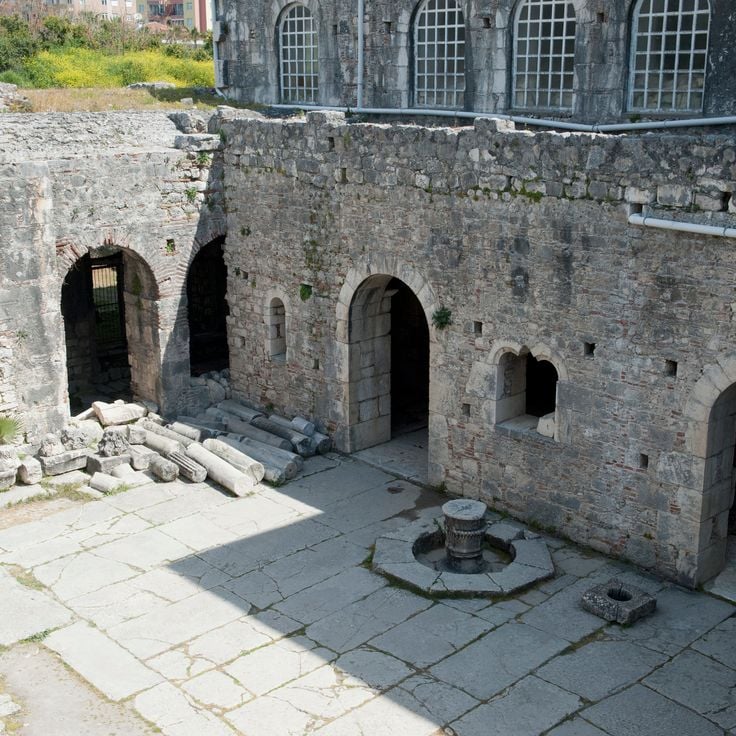
The Church of Saint Nicholas in Demre stands on the site where the bishop of Myra lived and worked in the 4th century. This man later became the inspiration for Santa Claus. The building has been rebuilt and expanded over time, but its mosaics, stone carvings, and burial chambers are still visible today. Walking through it gives a clear sense of how early Christian communities built their places of worship along this coast.
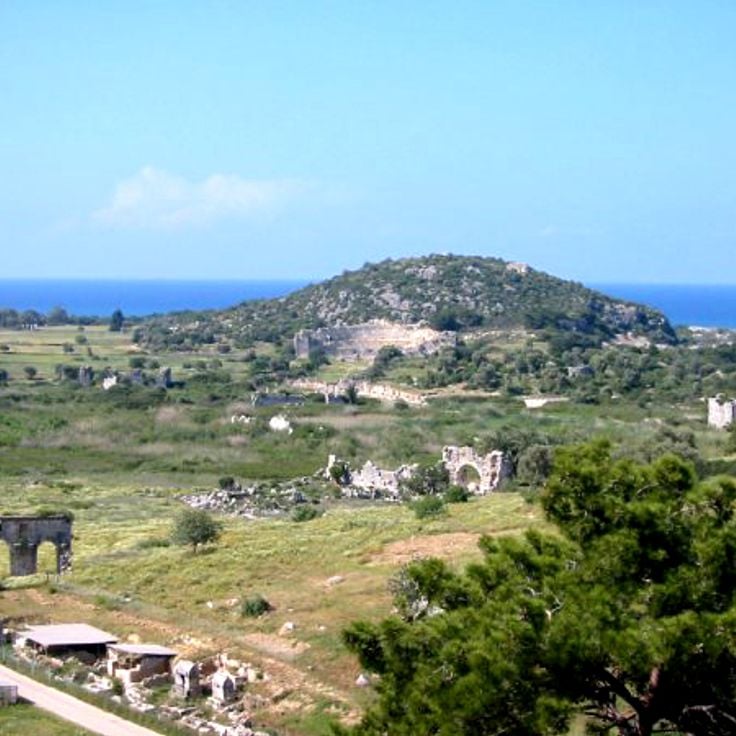
Patara was once one of the main cities of ancient Lycia. Today, its ruins sit quietly among sand dunes and low vegetation: a theater, a triumphal arch, a lighthouse. Just next to it lies one of the longest sandy beaches on the Turkish Mediterranean coast, stretching for nearly 11 miles (18 km). The beach is a protected nesting ground for sea turtles, which has kept it free of heavy development. Patara is a place where ancient ruins and open coastline meet in a way that feels natural and unforced.
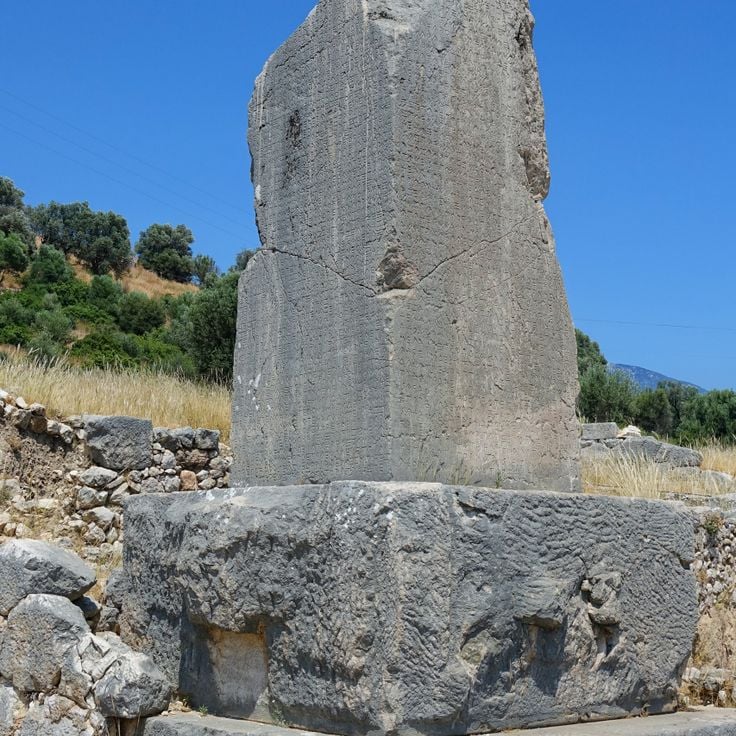
Xanthos was once the capital of Lycia, an ancient kingdom along the Turkish Mediterranean coast. The ruins sit on a hill above the plain and include a theater, temples, and tall pillar tombs carved with reliefs that are typical of Lycian culture. The site gives a clear sense of how important this city once was in the ancient world. Xanthos was added to the UNESCO World Heritage List in 1988, together with the nearby sanctuary of Letoon.
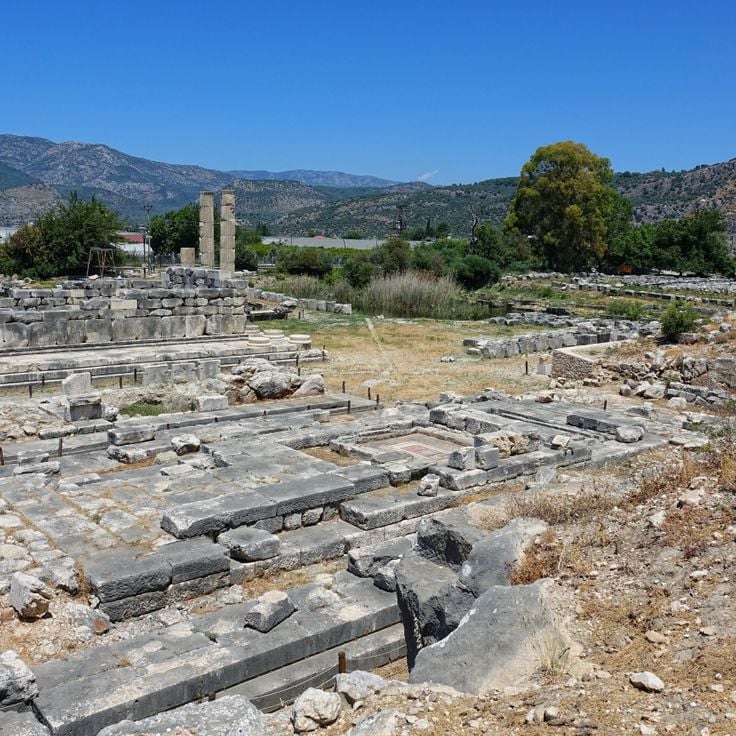
The Letoon sanctuary sits near the ancient city of Xanthos in southwestern Turkey and was the religious heart of Lycia. Three temples once stood side by side here: one for Leto, one for Artemis, and one for Apollo. Today you can still see their foundations, columns, and mosaic floors rising out of the water, as the ground has sunk over the centuries. Together with Xanthos, Letoon is a UNESCO World Heritage Site.
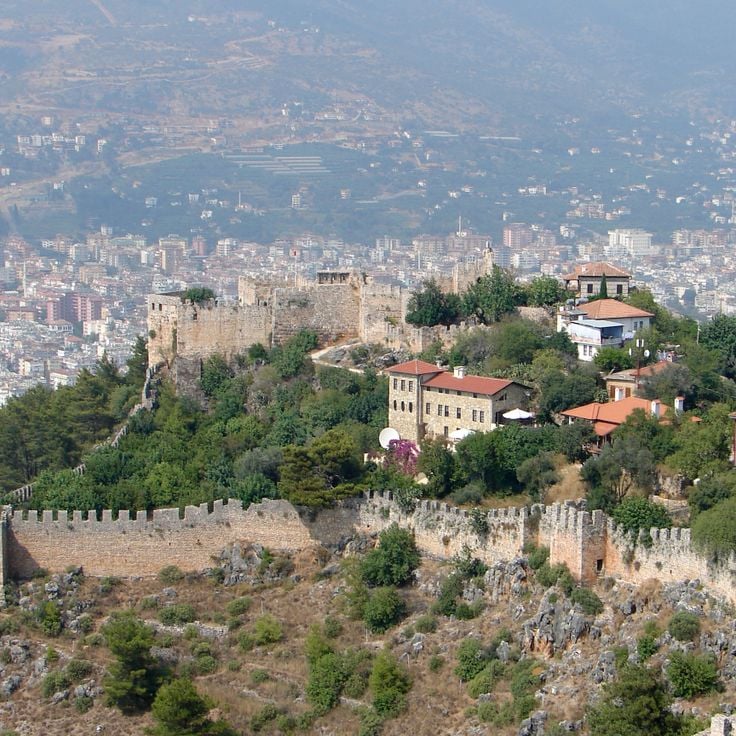
Alanya is a port town on the Turkish Mediterranean coast, built around a rocky headland topped by a large fortress. The walls date back to the Seljuk period and wrap around the entire peninsula. From up there, you get a wide view over the sea, the old town below, and the mountains behind. Inside the fortress, there are old houses, a Byzantine church, and a watchtower. Down at sea level, the Red Tower, also built by the Seljuks, stands right at the harbor entrance.
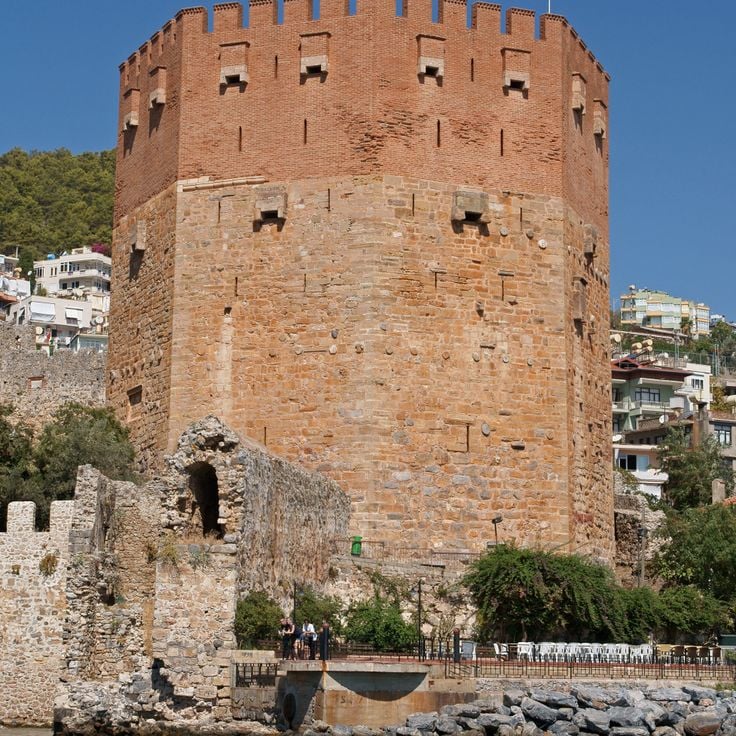
The Red Tower and the Seljuk shipyard in Alanya form a medieval ensemble at the base of the fortress. The Red Tower was built in the 13th century to protect the harbor and is today the most recognizable landmark in the city. Its octagonal shape in red brick stands out clearly against the sea. Right next to it, the old shipyard is where ships were once built and repaired. Five arched galleries open toward the water, making it easy to picture how vessels once moved in and out.
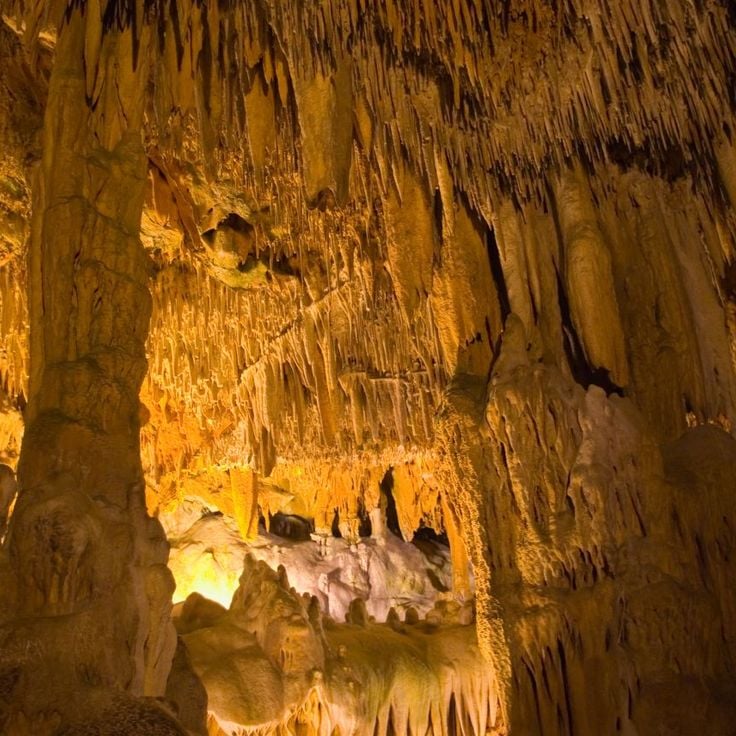
Damlataş Cave sits just steps from the beach in Alanya. It was discovered in the 20th century when workers were blasting rock near the castle hill. Inside, stalactites hang from the ceiling while stalagmites rise from the floor. The air is warm and humid, and the light catches the limestone formations in soft tones. A visit here is short but pairs naturally with time at the nearby beach.
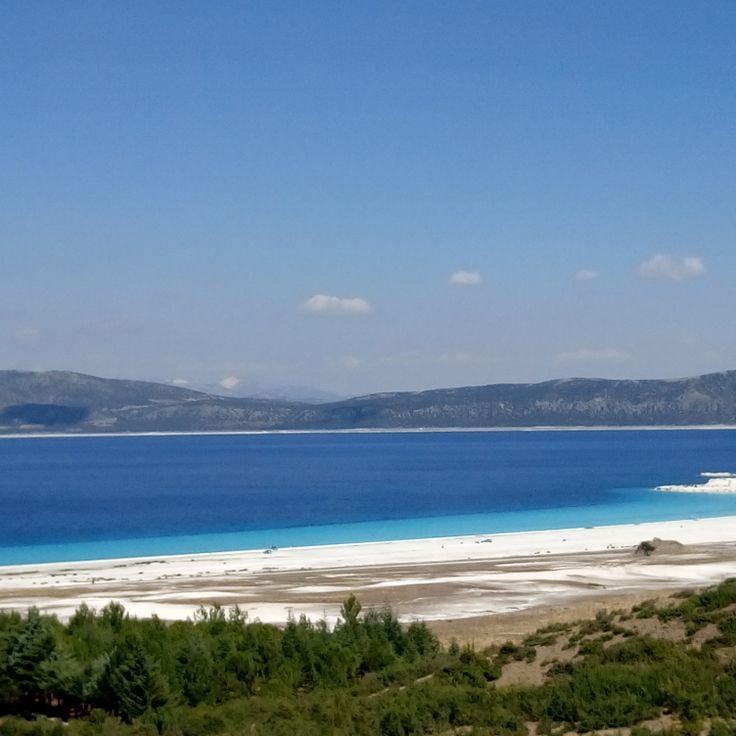
Lake Salda sits in the province of Burdur, far from the coast, and surprises visitors with its pale, almost white shores and unusually blue water. The white material along the beach comes from magnesium carbonate deposits that have built up over time. The water color shifts depending on the light and the depth, but it stays a clear, pale blue for most of the day. This lake is one of the few places in Turkey where the water and the surrounding landscape look nothing like the rest of the country.
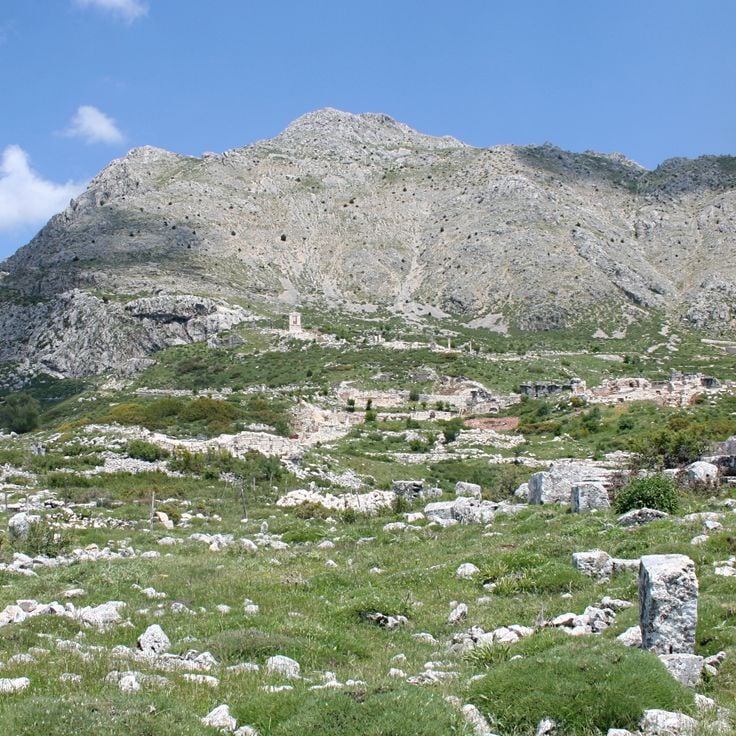
Sagalassos sits at over 5,600 feet (1,700 m) above sea level in the mountains of Burdur province, making it one of the best-preserved ancient cities in Turkey. Once a major center of the Greco-Roman world, the site still has a monumental fountain, an agora, and a theater standing in good condition. Walking through the ruins, you get a strong sense of how large and organized this city once was. The high altitude and dry air have helped protect the stone over the centuries. The mountain setting adds a raw, open quality to the whole experience.
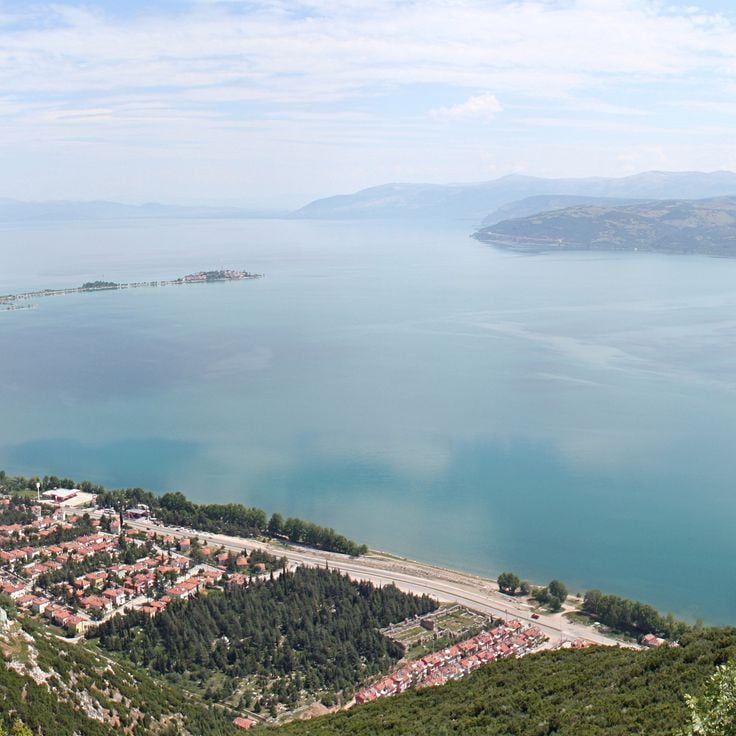
Lake Eğirdir sits in the heart of the Isparta region, far from the Mediterranean coast. It is one of the largest freshwater lakes in Turkey, surrounded by mountains and green valleys. Apple orchards line its shores, and small villages dot the landscape around it. This is a very different side of Mediterranean Turkey, where the pace slows down and the scenery shifts from sea and ruins to water, fruit trees, and open sky.
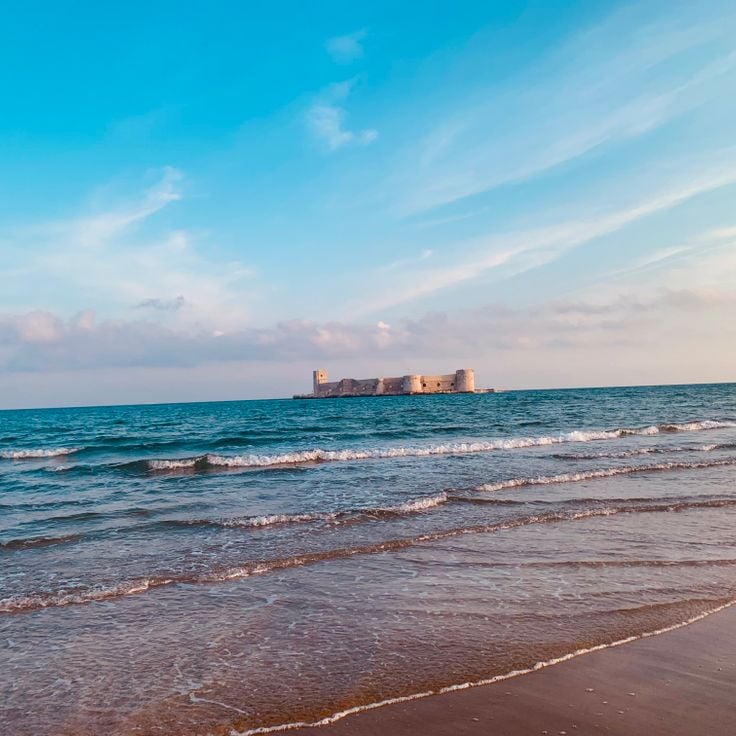
Kızkalesi is a medieval castle built on a small island just off the coast of Mersin. You can see it clearly from the beach: a tower rising out of the sea, surrounded by open water. On the mainland, facing the island, stands a second castle. Together, the two fortresses once controlled access to this stretch of coastline. The area belongs to the ancient region of Cilicia, where many traces of past civilizations are still visible today.
The ancient city of Anemurium sits at the southernmost tip of the Turkish coast, where the ruins meet the sea almost directly. This Greek and Roman site was once a busy port city, and today it is one of the most complete of its kind along this coastline. You can walk through the remains of baths, churches, and houses while the Mediterranean stretches out in front of you. The necropolis is particularly striking: hundreds of tomb towers still stand upright among the grass and scrub. Some buildings still have their mosaic floors intact. Because Anemurium sits far from the main tourist routes, the site is often nearly empty, giving visitors a rare chance to explore at their own pace.
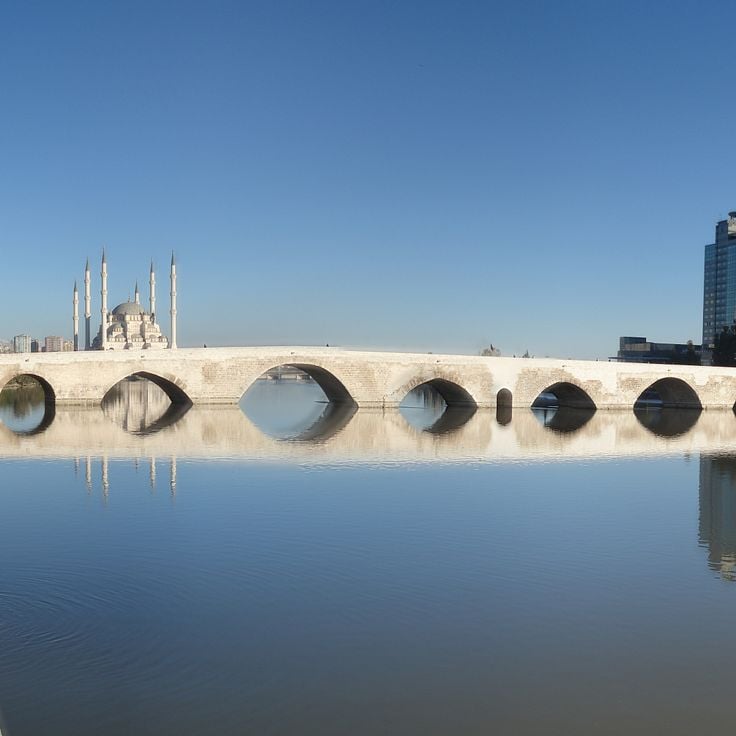
Adana sits in the eastern part of the Turkish Mediterranean coast, on the banks of the Seyhan River. The Taşköprü, a stone bridge built during the Roman period, has spanned the river for nearly 2000 years and is one of the oldest bridges still in use in Turkey. Around it, the old city unfolds with narrow streets, bazaars, and old caravanserais. The Sabancı Mosque, one of the largest in Turkey, rises over the city with its six minarets. Adana is also known for its food, especially the Adana kebab, served at street stalls and small restaurants throughout the center.
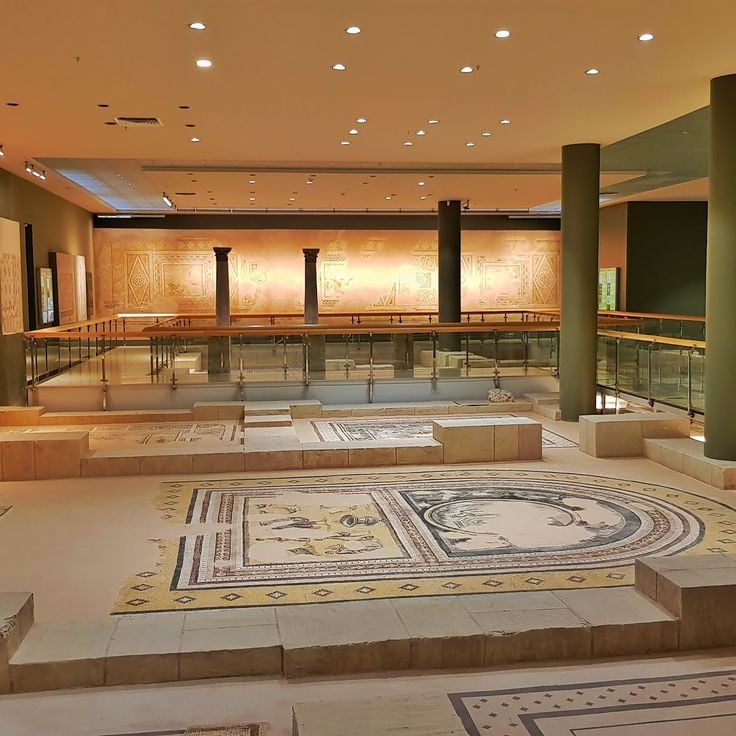
Antakya, the ancient Antioch, sits at the far eastern end of the Turkish Mediterranean coast and was once one of the greatest cities of the ancient world. Its old streets are lined with Ottoman-era houses, old churches and a lively market. The Hatay Archaeological Museum holds one of the largest collections of Roman mosaics anywhere, taken from the floors of villas and bathhouses that once stood here. Greeks, Romans, Byzantines, Arabs and Ottomans all left their mark on this city, and that layered past is still easy to read in the streets today.
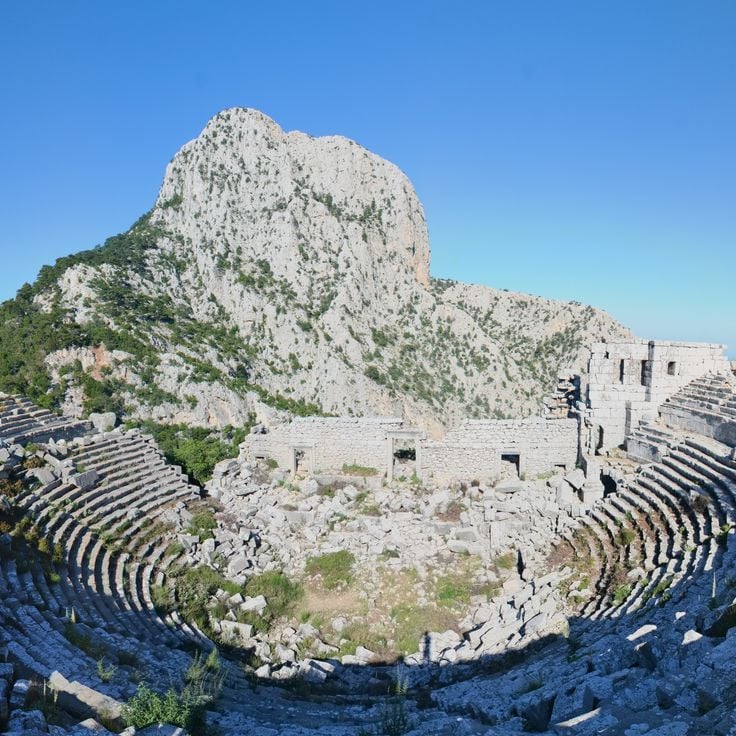
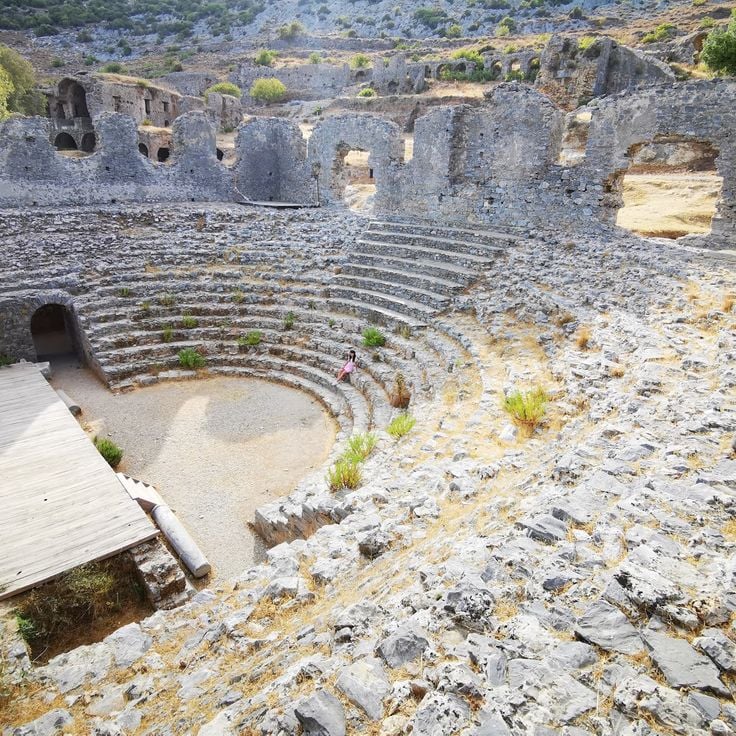
Termessos sits high in the Taurus Mountains, a short drive from Antalya. This ancient city was never taken by Alexander the Great, and the reason is still obvious today: the site is steep, rocky and hard to reach. Those who make the climb find a theater that has survived in remarkable condition, looking out over a wide mountain panorama. Around it lie columns, tombs and walls slowly reclaimed by trees and shrubs. There are no crowds here, no large visitor facilities, few signs. You walk among ruins and forest, with little between you and the past.
The old city of Antalya, known as Kaleiçi, sits just behind the ancient harbor. Narrow cobblestone streets run past Ottoman wooden houses with overhanging balconies. At nearly every turn, traces of different eras appear: Byzantine walls, a Roman tower, a medieval mosque. The Gate of Hadrian, built nearly 2,000 years ago, still stands at the old entrance to the city. Below, the small harbor is tucked between rocks and dotted with boats. Locals and visitors move through the same streets without any clear divide.
The Düden Waterfalls sit on the cliffs at the edge of Antalya and drop straight into the Mediterranean Sea. Fresh water meets salt water at the base of the falls, where the spray rises back up along the rocky face. You can watch from the clifftop path above, or take a boat to see the falls from the sea. The sound carries far, and the mist reaches you before you even see the water falling.
The ancient theater of Aspendos, near Antalya, is one of the best-preserved Roman theaters anywhere. Built in the 2nd century, it could seat around 15,000 people. The stone seating, the stage, and the tall backdrop wall are nearly intact. Walking in, you get a real sense of how a Roman crowd would have gathered here. In summer, concerts and performances are still held on the original stage.
The ancient city of Perge sits a short drive from Antalya and stands as one of the most complete Greco-Roman cities on the Turkish Mediterranean coast. Walking through the main gate, a wide colonnaded avenue opens up ahead, flanked by the ruins of baths, a market, a theater, and a stadium. The stones are well laid out, and the scale of the city gives a real sense of how large and active it once was.
Side is an ancient city on the Turkish Mediterranean coast where the remains of a Greek and Roman past are still standing in the middle of a lived-in town. The temple of Apollo sits right at the water's edge, its columns silhouetted against the sea. Around it, an old theater, stone streets, and city walls tell the story of a place that was once a major port. Today, people walk through these ruins as part of everyday life.
Köprülü Canyon National Park sits in the mountains behind the Antalya coast. The Köprüçay River runs through it, carving a deep gorge into the rock and flowing in a clear turquoise color. The canyon draws many visitors for rafting trips on the fast-moving water. Two old Roman bridges still cross the river at narrow points, and they have stood in place for nearly 2,000 years. Hiking trails run along the canyon walls through pine forest. The park feels far removed from the coast, even though the sea is only a short drive away.
Olympos, this ancient Lycian city, welcomes you with its ruins scattered across a wooded valley that gently slopes down to a long sandy beach. As you walk the path, you pass by wall remnants, discover sarcophagi, and catch sight of temple fragments half-buried under vegetation. As you progress, the Mediterranean gradually reveals itself. What strikes you here is the closeness between two worlds: just a few minutes' walk separate the stones of the past from the shore where the waves break.
The Chimaera of Yanartaş is a hillside on Mount Olimpos where flames rise straight out of the rock. The gas feeding these flames has been seeping through the ground for centuries, burning without interruption. The ancient Greeks placed here the fire-breathing monster described by Homer. Today, you can climb up at night and watch the flames glow in the dark, surrounded by pine trees and old ruins.
The beach of Çıralı sits at the foot of a forested mountain, where pine trees come down almost to the water. Behind the beach, a small village stretches along a dirt road: no large hotels, no loud music, just simple guesthouses and restaurants shaded by trees. The beach is long, covered with fine gravel, and the water is clear. At night, sea turtles come ashore to lay their eggs, which makes this stretch of coast one of the few in Turkey where nature still sets the pace.
Phaselis sits on a wooded peninsula along the Turkish Mediterranean coast, where the remains of a Greek and Roman city meet the sea. The site once had three harbors, and you can still walk along the old colonnaded main street, pass the ruins of a theater, and reach small sandy coves within a few minutes. Pine trees grow between the ancient stones. It is a place where you can explore ruins in the morning and swim in calm water by noon.
Kekova is a small island off the Mediterranean coast of Turkey, where the remains of an ancient city lie just beneath the surface of the water. From a boat, you can see submerged walls, steps, and foundations through the shallow water without diving. Earthquakes in antiquity pulled this city into the sea. Today, small boats drift slowly over the ruins, while the village of Üçağız and Lycian rock tombs carved into the cliffs are visible along the shore nearby.
Kaleköy, the ancient Simena, can only be reached by boat or on foot. The village sits at the edge of the sea, with a medieval fortress rising above its rooftops and Lycian rock tombs carved into the hillside all around. The houses are close together, the lanes are steep and narrow, and the water below is clear enough to see the bottom. There are no roads for cars, which gives the place a pace of life that feels rare along this stretch of the Turkish Mediterranean coast.
Myra, an ancient city near present-day Demre, is one of the best-known Lycian sites along the Turkish Mediterranean coast. Its rock-cut tombs are carved directly into the cliff face, stacked on top of one another like the floors of a building. Their facades imitate the doors and windows of old Lycian wooden houses. Below the cliff stands the ancient theater, still largely intact, giving a clear sense of how large this city once was.
The Church of Saint Nicholas in Demre stands on the site where the bishop of Myra lived and worked in the 4th century. This man later became the inspiration for Santa Claus. The building has been rebuilt and expanded over time, but its mosaics, stone carvings, and burial chambers are still visible today. Walking through it gives a clear sense of how early Christian communities built their places of worship along this coast.
Patara was once one of the main cities of ancient Lycia. Today, its ruins sit quietly among sand dunes and low vegetation: a theater, a triumphal arch, a lighthouse. Just next to it lies one of the longest sandy beaches on the Turkish Mediterranean coast, stretching for nearly 11 miles (18 km). The beach is a protected nesting ground for sea turtles, which has kept it free of heavy development. Patara is a place where ancient ruins and open coastline meet in a way that feels natural and unforced.
Xanthos was once the capital of Lycia, an ancient kingdom along the Turkish Mediterranean coast. The ruins sit on a hill above the plain and include a theater, temples, and tall pillar tombs carved with reliefs that are typical of Lycian culture. The site gives a clear sense of how important this city once was in the ancient world. Xanthos was added to the UNESCO World Heritage List in 1988, together with the nearby sanctuary of Letoon.
The Letoon sanctuary sits near the ancient city of Xanthos in southwestern Turkey and was the religious heart of Lycia. Three temples once stood side by side here: one for Leto, one for Artemis, and one for Apollo. Today you can still see their foundations, columns, and mosaic floors rising out of the water, as the ground has sunk over the centuries. Together with Xanthos, Letoon is a UNESCO World Heritage Site.
Alanya is a port town on the Turkish Mediterranean coast, built around a rocky headland topped by a large fortress. The walls date back to the Seljuk period and wrap around the entire peninsula. From up there, you get a wide view over the sea, the old town below, and the mountains behind. Inside the fortress, there are old houses, a Byzantine church, and a watchtower. Down at sea level, the Red Tower, also built by the Seljuks, stands right at the harbor entrance.
The Red Tower and the Seljuk shipyard in Alanya form a medieval ensemble at the base of the fortress. The Red Tower was built in the 13th century to protect the harbor and is today the most recognizable landmark in the city. Its octagonal shape in red brick stands out clearly against the sea. Right next to it, the old shipyard is where ships were once built and repaired. Five arched galleries open toward the water, making it easy to picture how vessels once moved in and out.
Damlataş Cave sits just steps from the beach in Alanya. It was discovered in the 20th century when workers were blasting rock near the castle hill. Inside, stalactites hang from the ceiling while stalagmites rise from the floor. The air is warm and humid, and the light catches the limestone formations in soft tones. A visit here is short but pairs naturally with time at the nearby beach.
Lake Salda sits in the province of Burdur, far from the coast, and surprises visitors with its pale, almost white shores and unusually blue water. The white material along the beach comes from magnesium carbonate deposits that have built up over time. The water color shifts depending on the light and the depth, but it stays a clear, pale blue for most of the day. This lake is one of the few places in Turkey where the water and the surrounding landscape look nothing like the rest of the country.
Sagalassos sits at over 5,600 feet (1,700 m) above sea level in the mountains of Burdur province, making it one of the best-preserved ancient cities in Turkey. Once a major center of the Greco-Roman world, the site still has a monumental fountain, an agora, and a theater standing in good condition. Walking through the ruins, you get a strong sense of how large and organized this city once was. The high altitude and dry air have helped protect the stone over the centuries. The mountain setting adds a raw, open quality to the whole experience.
Lake Eğirdir sits in the heart of the Isparta region, far from the Mediterranean coast. It is one of the largest freshwater lakes in Turkey, surrounded by mountains and green valleys. Apple orchards line its shores, and small villages dot the landscape around it. This is a very different side of Mediterranean Turkey, where the pace slows down and the scenery shifts from sea and ruins to water, fruit trees, and open sky.
Kızkalesi is a medieval castle built on a small island just off the coast of Mersin. You can see it clearly from the beach: a tower rising out of the sea, surrounded by open water. On the mainland, facing the island, stands a second castle. Together, the two fortresses once controlled access to this stretch of coastline. The area belongs to the ancient region of Cilicia, where many traces of past civilizations are still visible today.
The ancient city of Anemurium sits at the southernmost tip of the Turkish coast, where the ruins meet the sea almost directly. This Greek and Roman site was once a busy port city, and today it is one of the most complete of its kind along this coastline. You can walk through the remains of baths, churches, and houses while the Mediterranean stretches out in front of you. The necropolis is particularly striking: hundreds of tomb towers still stand upright among the grass and scrub. Some buildings still have their mosaic floors intact. Because Anemurium sits far from the main tourist routes, the site is often nearly empty, giving visitors a rare chance to explore at their own pace.
Adana sits in the eastern part of the Turkish Mediterranean coast, on the banks of the Seyhan River. The Taşköprü, a stone bridge built during the Roman period, has spanned the river for nearly 2000 years and is one of the oldest bridges still in use in Turkey. Around it, the old city unfolds with narrow streets, bazaars, and old caravanserais. The Sabancı Mosque, one of the largest in Turkey, rises over the city with its six minarets. Adana is also known for its food, especially the Adana kebab, served at street stalls and small restaurants throughout the center.
Antakya, the ancient Antioch, sits at the far eastern end of the Turkish Mediterranean coast and was once one of the greatest cities of the ancient world. Its old streets are lined with Ottoman-era houses, old churches and a lively market. The Hatay Archaeological Museum holds one of the largest collections of Roman mosaics anywhere, taken from the floors of villas and bathhouses that once stood here. Greeks, Romans, Byzantines, Arabs and Ottomans all left their mark on this city, and that layered past is still easy to read in the streets today.
Termessos sits high in the Taurus Mountains, a short drive from Antalya. This ancient city was never taken by Alexander the Great, and the reason is still obvious today: the site is steep, rocky and hard to reach. Those who make the climb find a theater that has survived in remarkable condition, looking out over a wide mountain panorama. Around it lie columns, tombs and walls slowly reclaimed by trees and shrubs. There are no crowds here, no large visitor facilities, few signs. You walk among ruins and forest, with little between you and the past.
The old city of Antalya, known as Kaleiçi, sits just behind the ancient harbor. Narrow cobblestone streets run past Ottoman wooden houses with overhanging balconies. At nearly every turn, traces of different eras appear: Byzantine walls, a Roman tower, a medieval mosque. The Gate of Hadrian, built nearly 2,000 years ago, still stands at the old entrance to the city. Below, the small harbor is tucked between rocks and dotted with boats. Locals and visitors move through the same streets without any clear divide.
The Düden Waterfalls sit on the cliffs at the edge of Antalya and drop straight into the Mediterranean Sea. Fresh water meets salt water at the base of the falls, where the spray rises back up along the rocky face. You can watch from the clifftop path above, or take a boat to see the falls from the sea. The sound carries far, and the mist reaches you before you even see the water falling.
The ancient theater of Aspendos, near Antalya, is one of the best-preserved Roman theaters anywhere. Built in the 2nd century, it could seat around 15,000 people. The stone seating, the stage, and the tall backdrop wall are nearly intact. Walking in, you get a real sense of how a Roman crowd would have gathered here. In summer, concerts and performances are still held on the original stage.
The ancient city of Perge sits a short drive from Antalya and stands as one of the most complete Greco-Roman cities on the Turkish Mediterranean coast. Walking through the main gate, a wide colonnaded avenue opens up ahead, flanked by the ruins of baths, a market, a theater, and a stadium. The stones are well laid out, and the scale of the city gives a real sense of how large and active it once was.
Side is an ancient city on the Turkish Mediterranean coast where the remains of a Greek and Roman past are still standing in the middle of a lived-in town. The temple of Apollo sits right at the water's edge, its columns silhouetted against the sea. Around it, an old theater, stone streets, and city walls tell the story of a place that was once a major port. Today, people walk through these ruins as part of everyday life.
Köprülü Canyon National Park sits in the mountains behind the Antalya coast. The Köprüçay River runs through it, carving a deep gorge into the rock and flowing in a clear turquoise color. The canyon draws many visitors for rafting trips on the fast-moving water. Two old Roman bridges still cross the river at narrow points, and they have stood in place for nearly 2,000 years. Hiking trails run along the canyon walls through pine forest. The park feels far removed from the coast, even though the sea is only a short drive away.
Olympos, this ancient Lycian city, welcomes you with its ruins scattered across a wooded valley that gently slopes down to a long sandy beach. As you walk the path, you pass by wall remnants, discover sarcophagi, and catch sight of temple fragments half-buried under vegetation. As you progress, the Mediterranean gradually reveals itself. What strikes you here is the closeness between two worlds: just a few minutes' walk separate the stones of the past from the shore where the waves break.
The Chimaera of Yanartaş is a hillside on Mount Olimpos where flames rise straight out of the rock. The gas feeding these flames has been seeping through the ground for centuries, burning without interruption. The ancient Greeks placed here the fire-breathing monster described by Homer. Today, you can climb up at night and watch the flames glow in the dark, surrounded by pine trees and old ruins.
The beach of Çıralı sits at the foot of a forested mountain, where pine trees come down almost to the water. Behind the beach, a small village stretches along a dirt road: no large hotels, no loud music, just simple guesthouses and restaurants shaded by trees. The beach is long, covered with fine gravel, and the water is clear. At night, sea turtles come ashore to lay their eggs, which makes this stretch of coast one of the few in Turkey where nature still sets the pace.
Phaselis sits on a wooded peninsula along the Turkish Mediterranean coast, where the remains of a Greek and Roman city meet the sea. The site once had three harbors, and you can still walk along the old colonnaded main street, pass the ruins of a theater, and reach small sandy coves within a few minutes. Pine trees grow between the ancient stones. It is a place where you can explore ruins in the morning and swim in calm water by noon.
Kekova is a small island off the Mediterranean coast of Turkey, where the remains of an ancient city lie just beneath the surface of the water. From a boat, you can see submerged walls, steps, and foundations through the shallow water without diving. Earthquakes in antiquity pulled this city into the sea. Today, small boats drift slowly over the ruins, while the village of Üçağız and Lycian rock tombs carved into the cliffs are visible along the shore nearby.
Kaleköy, the ancient Simena, can only be reached by boat or on foot. The village sits at the edge of the sea, with a medieval fortress rising above its rooftops and Lycian rock tombs carved into the hillside all around. The houses are close together, the lanes are steep and narrow, and the water below is clear enough to see the bottom. There are no roads for cars, which gives the place a pace of life that feels rare along this stretch of the Turkish Mediterranean coast.
Myra, an ancient city near present-day Demre, is one of the best-known Lycian sites along the Turkish Mediterranean coast. Its rock-cut tombs are carved directly into the cliff face, stacked on top of one another like the floors of a building. Their facades imitate the doors and windows of old Lycian wooden houses. Below the cliff stands the ancient theater, still largely intact, giving a clear sense of how large this city once was.
The Church of Saint Nicholas in Demre stands on the site where the bishop of Myra lived and worked in the 4th century. This man later became the inspiration for Santa Claus. The building has been rebuilt and expanded over time, but its mosaics, stone carvings, and burial chambers are still visible today. Walking through it gives a clear sense of how early Christian communities built their places of worship along this coast.
Patara was once one of the main cities of ancient Lycia. Today, its ruins sit quietly among sand dunes and low vegetation: a theater, a triumphal arch, a lighthouse. Just next to it lies one of the longest sandy beaches on the Turkish Mediterranean coast, stretching for nearly 11 miles (18 km). The beach is a protected nesting ground for sea turtles, which has kept it free of heavy development. Patara is a place where ancient ruins and open coastline meet in a way that feels natural and unforced.
Xanthos was once the capital of Lycia, an ancient kingdom along the Turkish Mediterranean coast. The ruins sit on a hill above the plain and include a theater, temples, and tall pillar tombs carved with reliefs that are typical of Lycian culture. The site gives a clear sense of how important this city once was in the ancient world. Xanthos was added to the UNESCO World Heritage List in 1988, together with the nearby sanctuary of Letoon.
The Letoon sanctuary sits near the ancient city of Xanthos in southwestern Turkey and was the religious heart of Lycia. Three temples once stood side by side here: one for Leto, one for Artemis, and one for Apollo. Today you can still see their foundations, columns, and mosaic floors rising out of the water, as the ground has sunk over the centuries. Together with Xanthos, Letoon is a UNESCO World Heritage Site.
Alanya is a port town on the Turkish Mediterranean coast, built around a rocky headland topped by a large fortress. The walls date back to the Seljuk period and wrap around the entire peninsula. From up there, you get a wide view over the sea, the old town below, and the mountains behind. Inside the fortress, there are old houses, a Byzantine church, and a watchtower. Down at sea level, the Red Tower, also built by the Seljuks, stands right at the harbor entrance.
The Red Tower and the Seljuk shipyard in Alanya form a medieval ensemble at the base of the fortress. The Red Tower was built in the 13th century to protect the harbor and is today the most recognizable landmark in the city. Its octagonal shape in red brick stands out clearly against the sea. Right next to it, the old shipyard is where ships were once built and repaired. Five arched galleries open toward the water, making it easy to picture how vessels once moved in and out.
Damlataş Cave sits just steps from the beach in Alanya. It was discovered in the 20th century when workers were blasting rock near the castle hill. Inside, stalactites hang from the ceiling while stalagmites rise from the floor. The air is warm and humid, and the light catches the limestone formations in soft tones. A visit here is short but pairs naturally with time at the nearby beach.
Lake Salda sits in the province of Burdur, far from the coast, and surprises visitors with its pale, almost white shores and unusually blue water. The white material along the beach comes from magnesium carbonate deposits that have built up over time. The water color shifts depending on the light and the depth, but it stays a clear, pale blue for most of the day. This lake is one of the few places in Turkey where the water and the surrounding landscape look nothing like the rest of the country.
Sagalassos sits at over 5,600 feet (1,700 m) above sea level in the mountains of Burdur province, making it one of the best-preserved ancient cities in Turkey. Once a major center of the Greco-Roman world, the site still has a monumental fountain, an agora, and a theater standing in good condition. Walking through the ruins, you get a strong sense of how large and organized this city once was. The high altitude and dry air have helped protect the stone over the centuries. The mountain setting adds a raw, open quality to the whole experience.
Lake Eğirdir sits in the heart of the Isparta region, far from the Mediterranean coast. It is one of the largest freshwater lakes in Turkey, surrounded by mountains and green valleys. Apple orchards line its shores, and small villages dot the landscape around it. This is a very different side of Mediterranean Turkey, where the pace slows down and the scenery shifts from sea and ruins to water, fruit trees, and open sky.
Kızkalesi is a medieval castle built on a small island just off the coast of Mersin. You can see it clearly from the beach: a tower rising out of the sea, surrounded by open water. On the mainland, facing the island, stands a second castle. Together, the two fortresses once controlled access to this stretch of coastline. The area belongs to the ancient region of Cilicia, where many traces of past civilizations are still visible today.
The ancient city of Anemurium sits at the southernmost tip of the Turkish coast, where the ruins meet the sea almost directly. This Greek and Roman site was once a busy port city, and today it is one of the most complete of its kind along this coastline. You can walk through the remains of baths, churches, and houses while the Mediterranean stretches out in front of you. The necropolis is particularly striking: hundreds of tomb towers still stand upright among the grass and scrub. Some buildings still have their mosaic floors intact. Because Anemurium sits far from the main tourist routes, the site is often nearly empty, giving visitors a rare chance to explore at their own pace.
Adana sits in the eastern part of the Turkish Mediterranean coast, on the banks of the Seyhan River. The Taşköprü, a stone bridge built during the Roman period, has spanned the river for nearly 2000 years and is one of the oldest bridges still in use in Turkey. Around it, the old city unfolds with narrow streets, bazaars, and old caravanserais. The Sabancı Mosque, one of the largest in Turkey, rises over the city with its six minarets. Adana is also known for its food, especially the Adana kebab, served at street stalls and small restaurants throughout the center.
Antakya, the ancient Antioch, sits at the far eastern end of the Turkish Mediterranean coast and was once one of the greatest cities of the ancient world. Its old streets are lined with Ottoman-era houses, old churches and a lively market. The Hatay Archaeological Museum holds one of the largest collections of Roman mosaics anywhere, taken from the floors of villas and bathhouses that once stood here. Greeks, Romans, Byzantines, Arabs and Ottomans all left their mark on this city, and that layered past is still easy to read in the streets today.
Termessos sits high in the Taurus Mountains, a short drive from Antalya. This ancient city was never taken by Alexander the Great, and the reason is still obvious today: the site is steep, rocky and hard to reach. Those who make the climb find a theater that has survived in remarkable condition, looking out over a wide mountain panorama. Around it lie columns, tombs and walls slowly reclaimed by trees and shrubs. There are no crowds here, no large visitor facilities, few signs. You walk among ruins and forest, with little between you and the past.
Visiting this region in spring or autumn lets you avoid the summer crowds while still enjoying pleasant weather. Take the time to get lost in the small alleys of the coastal villages in the evening, when the locals come out for some air. That is where you will truly feel the rhythm of Mediterranean life.