Ishak Pasha Palace, Ottoman palace in Doğubayazıt, Turkey.
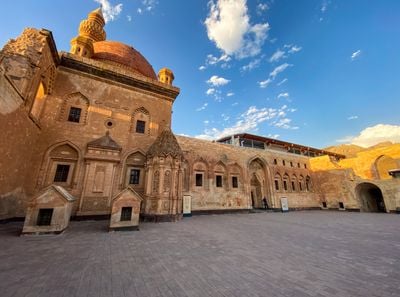
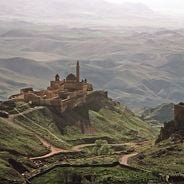
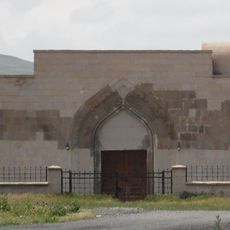
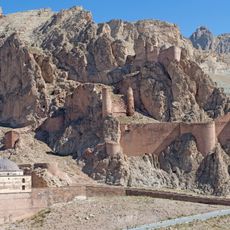
Ishak Pasha Palace is a semi-ruined palace and administrative complex on a high platform near Turkey's border with Iran. Its pale stone buildings, enclosed by high walls, include a mosque with a ribbed dome, a second smaller dome, a slender minaret with a conical cap, two courtyards, a harem, a library, and dungeons. A tall arched gateway with a small blue door faces left.
Construction began in 1685 under Çolak Abdi Pasha of the Çıldıroğulları, a family of hereditary Kurdish pashas, and was completed in 1784 by his descendant İshak Paşa, whose name appears on the harem door inscription of 1785. The palace was damaged by an earthquake in 1840, by the Russo-Turkish War of 1877–1878, and by gunfire in World War I; it later served as an administrative centre and military fort until 1937. It was added to the UNESCO Tentative List in 2000.
The palace's name comes from Ishak Pasha, who completed the harem in 1784, as recorded on its door inscription. The Kurdish scholar and poet Ahmed-i Hani worked as a secretary for the Bayezid beys, and his tomb, visited as a shrine, stands near the palace.
Access is through a steep road from Doğubayazıt that takes about ten minutes to drive and requires walking through areas with some uneven ground. Visitors should wear sturdy footwear as some sections have loose stones.
The complex includes a central heating system, listed among its sections alongside the dungeons, bakery and pantries. The palace appears on the reverse of the Turkish 100 new lira banknote issued between 2005 and 2009.
The community of curious travelers
AroundUs brings together thousands of curated places, local tips, and hidden gems, enriched daily by 93,342 contributors worldwide.