Manhattan Bridge, Suspension bridge in Lower Manhattan and Downtown Brooklyn, New York, United States
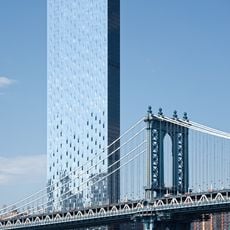
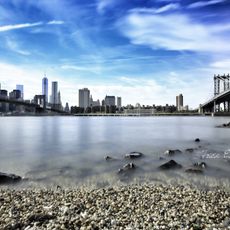
This steel structure spans the East River between Lower Manhattan and Brooklyn, linking both neighborhoods with two stacked levels of roadway. The steel towers rise above the water and hold four thick cables that support the weight of the decks, tracks, and continuous flow of traffic.
Proposed in 1898 as "Bridge No. 3" and renamed in 1902, the bridge had its tower foundations finished in 1904 and its towers in 1908. Leon Moisseiff's design, chosen after Gustav Lindenthal was dismissed, opened to traffic on December 31, 1909. Subway trains began using it in 1915, and uneven train loads forced a reconstruction between 1982 and 2004.
The bridge's name was contested: proposed as "Bridge No. 3" in 1898, it was renamed Manhattan Bridge in 1902, and The New York Times called the name "meaningless" and campaigned for Wallabout Bridge. Carrère and Hastings designed ornamental plazas at both ends, including the Manhattan arch and colonnade, a designated city landmark.
The walkway is on the west side of the bridge and the bikeway on the east; the original south walkway reopened in June 2001 after sixty years, and the north-side bike path opened in late summer 2004. About 4,000 cyclists cross daily, alongside some 85,400 vehicles and 950 trains.
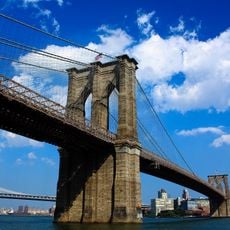
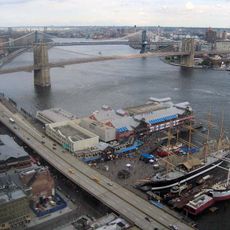
Subway trains on the B, D, N, and Q lines rumble past on the lower deck, creating a rhythmic hum that can be heard from the walkway above. The view from the center shows both the Brooklyn Bridge and the Downtown Manhattan skyline in direct line of sight.
The community of curious travelers
AroundUs brings together thousands of curated places, local tips, and hidden gems, enriched daily by 92,381 contributors worldwide.