Coria gate, Medieval gate in Cáceres, Spain
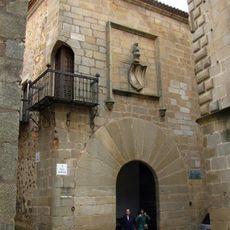
The Coria gate no longer stands: it was demolished in 1879 and its site is now the Plaza del Socorro, where a garden displays remains of the Roman wall beside the gate's former location. The surviving brick-vaulted arch nearby, over the Adarve Obispo Álvarez de Castro at the corner of Calle Tiendas, is a separate 18th-century structure linking two noble houses. The gate itself was a semicircular arch with cushioned voussoirs, similar to the Arco del Cristo, flanked by two towers later absorbed into neighbouring houses.
The gate was the northern of the four entrances to Roman Norba Caesarina, linked to the Vía de la Plata by a branch road. The wall was rebuilt under Almohad rule, and tradition holds that Alfonso IX of León entered Cáceres through this gate in 1229. It stood until 1879, when Joaquín Muñoz Chaves obtained permission to demolish it, using the materials himself; the Real Academia de Bellas Artes de San Fernando objected too late.
The gate's other name, Arco del Socorro, comes from the image of the Virgin of Socorro placed in a niche above the arch after the Christian conquest of the 13th century; by 1742 it was already called puerta de Nra. Sra. del Socorro. The polychrome carving, about 30 cm high and dated to the 17th century, was moved after the 1879 demolition and displayed from 1940 in a grilled niche on the Casa de los Condes de Trespalacios, until it disappeared in the early 21st century.
The gate no longer stands: it was demolished in 1879 and its site is now Plaza del Socorro, in the old town. A garden there displays remains of the Roman wall beside the gate's former location. The surviving brick arch from the 18th century, which linked two noble houses, is nearby over Calle Adarve Obispo Álvarez de Castro at the corner with Calle Tiendas.
The gate was demolished in 1879 by Joaquín Muñoz Chaves, who used the resulting materials for his own account, with the approval of the municipal architect Emilio María Rodríguez. The Real Academia de Bellas Artes de San Fernando objected, but its letter reached Cáceres in February 1880, after the demolition was already done.
The community of curious travelers
AroundUs brings together thousands of curated places, local tips, and hidden gems, enriched daily by 94,138 contributors worldwide.