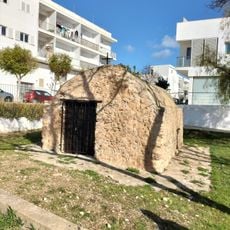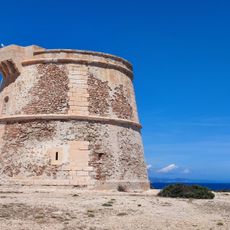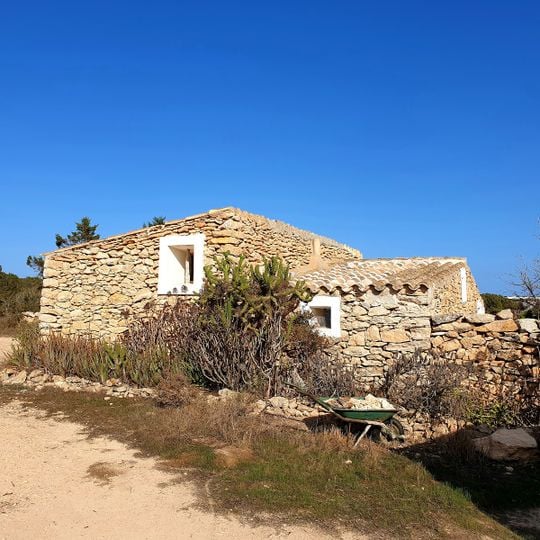
Dolmen de Ca na Costa, Prehistoric burial site in Formentera, Spain.
Dolmen de Ca na Costa is a megalithic passage grave on Formentera. Its central chamber is formed by seven vertical limestone slabs about 2 m high, set in a slightly elliptical circle. A corridor of parallel stones leads in through a perforated slab, and two dry-stone rings with radial stones surround the chamber.
Excavated in 1974, the tomb revealed prehistoric settlers on the Pitiüses islands and was used from 2040 to 1600 BCE, at the start of the Bronze Age. It held eight individuals—two women and six men—with small globular and hemispherical pottery, bone beads and fifteen buttons. Its discovery pushed back Formentera's known human presence, previously dated to the Punic period from the 4th century BCE.
Locals call the tomb "es Rellotge" (the clock) because its stones resemble a sundial. The 1974 discovery overturned the belief that Formentera's first inhabitants arrived with the Punic culture from the 4th century BCE, pushing human presence back to the Bronze Age.
The archaeological site is located between La Savina and Es Pujols near Estany Pudent lagoon, accessible via the Pm-V-820-2 road around kilometer 3. The outdoor setting is easy to navigate on foot once you arrive at the location.
Locals call the monument "es Rellotge" (the clock) because its layout resembles a sundial. The site also preserves a paved forecourt in front of the corridor and about 10 of an original 24 radial slabs around the chamber.
The community of curious travelers
AroundUs brings together thousands of curated places, local tips, and hidden gems, enriched daily by 93,431 contributors worldwide.