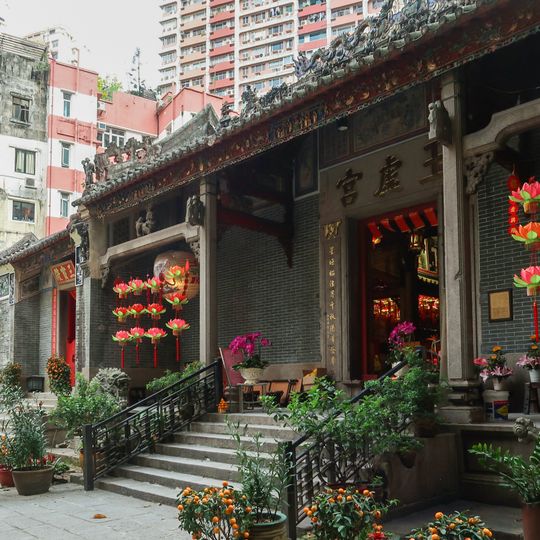
Wan Chai Pak Tai Temple, Taoist temple in Wan Chai District, Hong Kong.
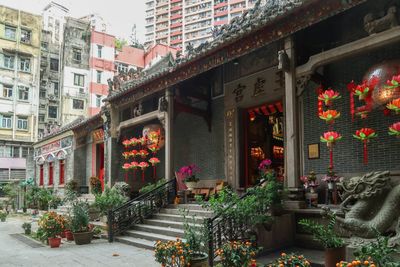
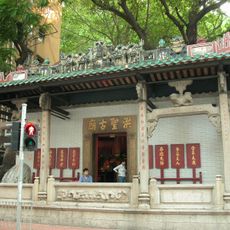
Wan Chai Pak Tai Temple, also called Yuk Hui Kung, is a grey-brick and stone Taoist temple on Lung On Street. Its three-hall, three-bay plan follows a courtyard layout. The overhanging roof ridge carries green, blue and red ceramic figures, and a carved stone frieze runs below the eaves. Stone lions bracket the facade, and red lanterns hang at the central doorway beneath three gold Chinese characters.
Built by Wan Chai residents in 1863 as Yuk Hui Kung, the temple was funded by local subscription and first restored in 1928, as a stele inside records. The government's Chinese Temples Committee spent over HK$10 million on a major renovation in 2005. It was graded a Grade I historic building on 17 May 2010 and declared a monument on 25 October 2019.
The temple's name Yuk Hui Kung, 'Palace of the Jade Void', refers to the heaven of Pak Tai, also called Xuan Tian Shang Di. Before World War II, the third day of the third lunar month brought opera performances for Pak Tai's birthday. The main hall holds separate altars to Ji Gong, Lü Dongbin, Guan Yu, the Three Immortal Maidens, Guanyin, the City God, Zhao Gongming and Bi Gan.
The temple is located on Lung On Street and can easily be reached from Wan Chai MTR station. Visitors should be aware that regular prayer times and ceremonies take place, so checking opening hours in advance or visiting during quieter periods makes for a better experience.
The 1603 bronze Pak Tai in the entrance hall weighs over 600 kg and bears an inscription saying it was originally set up at Bishan Gong, a Taoist temple in Guangdong. A Hong Kong merchant, Zeng Fu, bought it in Guangzhou in 1926 for HK$10,000 and kept it at his Kowloon City villa until the Japanese occupation levelled the site for the Kai Tak airport extension, after which it was moved here.
The community of curious travelers
AroundUs brings together thousands of curated places, local tips, and hidden gems, enriched daily by 93,121 contributors worldwide.