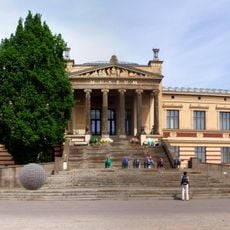
Archäologisches Landesmuseum Mecklenburg-Vorpommern, Archaeological state museum in Schwerin, Germany
The Archäologisches Landesmuseum Mecklenburg-Vorpommern, formerly the Museum für Ur- und Frühgeschichte Schwerin, held the state's archaeological collection in Schwerin until 1992. Its holdings include the Bronze Age cult wagon from Peckatel, the Horn of Wismar, the Roga dance ring and the Lübzin lurs. The collection is now mostly in storage and is to be shown again in a new museum in Rostock, with construction planned to start in 2026.
The collection traces back to ducal holdings of the mid-18th century and grew through the work of Georg Christian Friedrich Lisch and Robert Beltz, the 1834 antiquarian society, the Georgium antiquities from Neustrelitz and many school collections. Shown in the Schwerin museum from the 19th century, it was reorganized under Willy Bastian and displayed in Schwerin Castle from 1936. Cleared in 1942, it reopened there in 1958 as the Museum für Ur- und Frühgeschichte under Ewald Schuldt, and left the castle in 1992.
The museum displays Bronze Age objects that show how people lived in northern Germany thousands of years ago. Visitors can see tools, vessels, and ritual items that reveal the daily practices and beliefs of ancient communities.
The collection left Schwerin Castle in 1992 after the state parliament chose it as its seat and has since been kept mostly in storage. A new archaeological state museum is planned in Rostock, with construction scheduled to begin in 2026; until then the finds are not on public display.
The collection's showpieces include the Bronze Age cult wagon from Peckatel, the Horn of Wismar, the Roga dance ring and the lurs from Lübzin. Staff at the museum's branch offices also coordinated the voluntary excavation-monument care carried out by thousands of honorary wardens across the region.
The community of curious travelers
AroundUs brings together thousands of curated places, local tips, and hidden gems, enriched daily by 93,135 contributors worldwide.