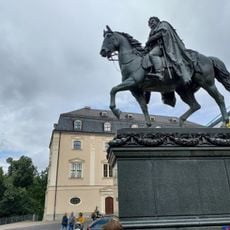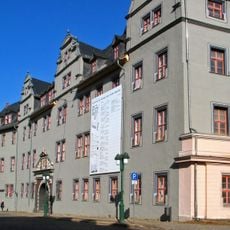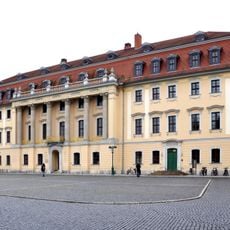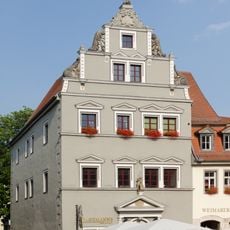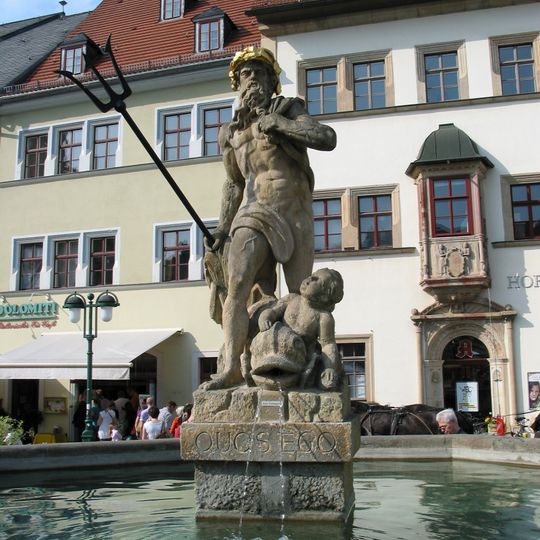
Fountains in Weimar, Public fountains throughout Weimar, Germany.
The fountains in Weimar are distributed water structures ranging from simple stone constructions to large decorative installations with classical sculptures. They define the cityscape at various squares and streets and contribute to a unified aesthetic impression.
Weimar's fountains were fed from the 17th century by a "Röhrenfahrtensystem": seven stone-lined spring chambers (Brunnenstuben) outside the city, in the Wallendorfer Grund, Kirschbachtal and Rabenwäldchen, led water through hollowed spruce trunks, later clay and cast-iron pipes, down to the town. By 1858 the conduits measured 12.5 km. From 1847/48 Grand Duchess Maria Pavlovna funded six running fountains, carved by Berka stonemason Carl Dornberger and marked with her monogram "MP".
Many Weimar fountains carry the monogram "MP" of Grand Duchess Maria Pavlovna, who from 1847/48 funded six running fountains, among them the Muschelbrunnen, Delphinbrunnen, Löwenbrunnen, Theaterbrunnen and Geleitbrunnen. The Berka sculptor Carl Dornberger made all of those she donated. Water spouts are often shaped as lion heads, the city's heraldic animal, or as grimacing faces meant to drive off evil spirits.
The fountains are located at different spots in the old town and are easy to reach on foot. Free city maps from the tourist office show their exact location in relation to other sights.
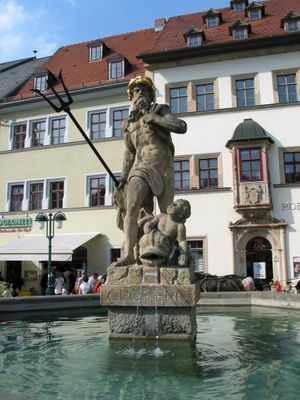
The oldest fountain, the Neptunbrunnen on the north edge of the market square, stands where a draw-well was first recorded in 1540; its Neptune figure was carved by court sculptor Martin Gottlieb Klauer. Many spouts take the form of lion heads, the city's heraldic animal, while grimacing faces were meant to drive off evil spirits.
The community of curious travelers
AroundUs brings together thousands of curated places, local tips, and hidden gems, enriched daily by 94,693 contributors worldwide.