Cranachhaus, Renaissance building in Weimar, Germany
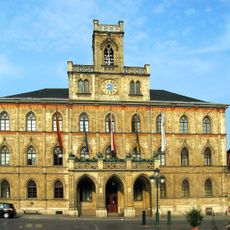
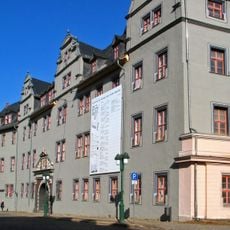
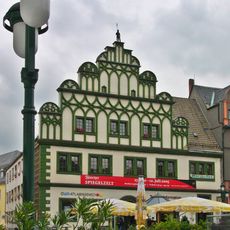
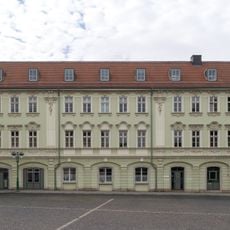
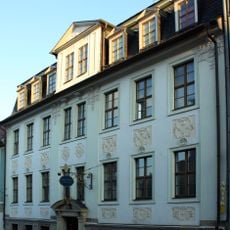
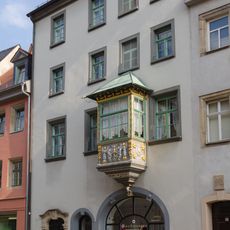
Cranachhaus is a Renaissance building on Weimar's marketplace featuring elaborate facade elements including decorative columns, shell niches, and round-arch ornaments. It stands opposite the town hall and defines much of the historic plaza's architectural character with its ornate design.
Nikolaus Gromann built the house between 1547 and 1549 for ducal chancellor Christian Brück, who was married to Barbara Cranach, a daughter of Lucas Cranach the Elder. Lucas Cranach the Elder spent his last year here after arriving in Weimar in 1552 at age 80, founding a workshop and taking on two pupils. He began the three-panel altarpiece in the attic studio, which his son Lucas Cranach the Younger completed in 1555. Damaged in World War II, the building was later rebuilt true to the original.
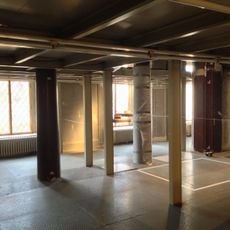
The house is named after Lucas Cranach the Elder, who moved in at age 80 in 1552 and set up a workshop with two pupils. Above the right arch is his coat of arms, a winged serpent. Since the gallery left in the late 1990s, the Theater im Gewölbe has staged small works by Goethe, Schiller and other classics here.
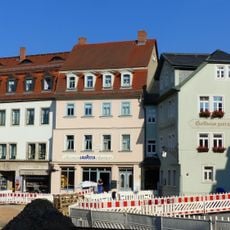
The building is not open to the public; only the facade on the east side of the market square, opposite the town hall, can be viewed from outside. The Theater im Gewölbe inside stages smaller works by Goethe, Schiller and other classics, so attendance is limited to performances. The two nearly identical houses are Markt 11 and 12, with the Cranachhaus on the left.
The winged serpent above the right arch is Lucas Cranach the Elder's coat of arms, shown with a ring in its mouth in the Spanish source. It marks the house built for Christian Brück, Cranach's son-in-law, not for the painter himself.
The community of curious travelers
AroundUs brings together thousands of curated places, local tips, and hidden gems, enriched daily by 94,419 contributors worldwide.