Blue Nile Falls

Log in to your account

AroundUs is a community-driven map of interesting places, built by curious explorers like you. It grows with every review, story, and photo you share.
Connect to save your favorite spots, contribute locations, and create personalized routes.
By continuing, you accept our Terms and Conditions and our Privacy Policy

Blue Nile Falls

Add to collection
Map
Suggest a change
Share

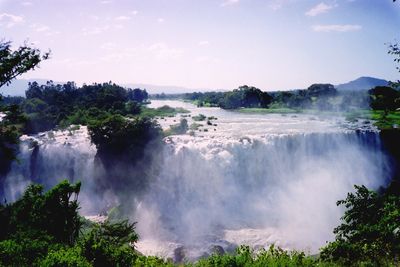
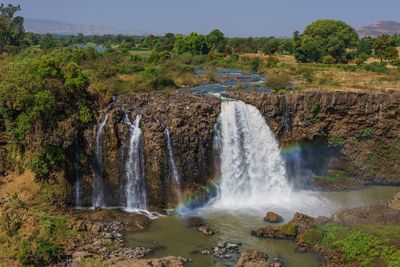
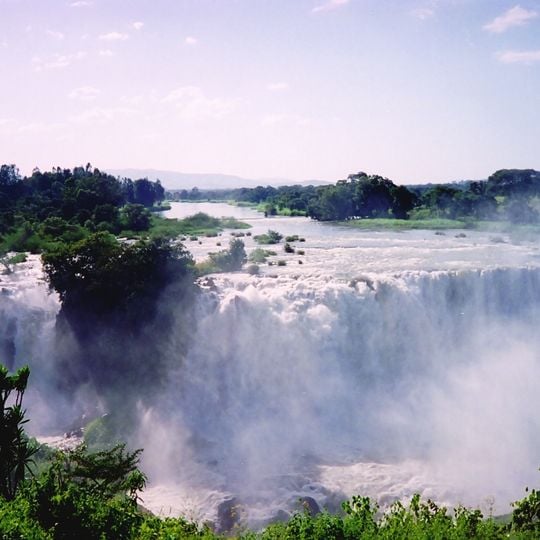
Blue Nile Falls, Ethiopian waterfall near Bahir Dar, Ethiopia

Water plunges 138 feet (42 meters) in multiple streams that create white water formations stretching 1,310 feet (400 meters) across during rainy season, with dense spray rising above the gorge.

Portuguese Jesuit missionary Pedro Paez documented the site in 1613, marking one of the first European encounters with this formation on the upper Nile watershed.

The local name Tis Abaya means 'Smoke of Water' in Amharic, describing the mist and spray visible from surrounding viewpoints used by communities for generations.

A hydroelectric dam upstream affects water flow during dry seasons, making September through October the optimal months for maximum volume, with access arranged through Bahir Dar located 19 miles (30 kilometers) northwest.

The site has contributed to Lake Tana's ecological isolation, leading to the development of distinct fish species found nowhere else in the Nile system, including several endemic cichlid varieties.

Location: Amhara Region

Height: 42 m

Part of: Blue Nile

GPS coordinates: 11.48788,37.58757

Latest update: December 2, 2025 11:13

The most beautiful waterfalls and cascades in the world

Waterfalls have a way of drawing people in. The sound of falling water, the mist that rises from the base, the way light catches the spray. Some of the most striking examples sit in places that remain relatively quiet, where the journey itself becomes part of the experience. These destinations reward travelers who make the effort, offering moments of solitude that are increasingly rare around natural landmarks. This collection includes places like the limestone terraces of Plitvice Lakes in Croatia, where a chain of interconnected pools spills from one to the next through forest shade. Or the red sandstone walls of Coyote Gulch in Utah, where water carved out hidden alcoves and pools over countless seasons. In India, Nohkalikai Falls drops from a forested plateau into a green pool far below. China's Huangguoshu Waterfall has a cave tucked behind the curtain of water itself. At the Vietnam-China border, Ban Gioc-Detian spreads wide across the landscape, while Angel Falls in Venezuela tumbles nearly a thousand meters from a flat topped mountain. Norway's Geirangerfjord hosts the Seven Sisters, a cluster of parallel streams that flow straight into the fjord. Iceland's Dettifoss sends an immense volume of glacial water over black volcanic rock. South Africa's Tugela Falls descends in stages from the dramatic cliff face of the Drakensberg range. And in the Philippines, Kawasan Falls creates a series of turquoise pools beneath a canopy of tropical growth. Each place has its own character, shaped by the rock, the climate, and the surrounding terrain.

Photography locations in Ethiopia

Ethiopia offers photographers a range of subjects from medieval architecture to geologically active zones. In the north, Lalibela features eleven churches carved from solid tuff rock during the 12th and 13th centuries, while Axum holds obelisks from the Aksumite Empire that flourished from the 1st to 10th centuries. The Gheralta region of Tigray contains dozens of churches built into cliff faces, accessible via steep trails.The landscape extends from the peaks of the Simien Mountains, rising above 15,000 feet (4,500 meters), to the Danakil Depression, one of the lowest and hottest places on Earth. Bale Mountains National Park supports Ethiopian wolves in afroalpine moorlands, while Awash National Park features acacia woodlands and hot springs. The walled city of Harar Jugol, with its 368 lanes and 82 mosques dating from the 16th century, displays Islamic architecture. The monasteries on Lake Tana islands hold manuscripts from the 14th to 18th centuries, and in Gondar, Fasil Ghebbi documents Ethiopian rule through its 17th and 18th century palaces and churches.

Reviews

Visited this place? Tap the stars to rate it and share your experience / photos with the community! Try now! You can cancel it anytime.

« Blue Nile Falls - Ethiopian waterfall near Bahir Dar, Ethiopia » is provided by Around Us (aroundus.com). Images and texts are derived from Wikimedia project under a Creative Commons license. You are allowed to copy, distribute, and modify copies of this page, under the conditions set by the license, as long as this note is clearly visible.

Discover hidden gems everywhere you go!

From secret cafés to breathtaking viewpoints, skip the crowded tourist spots and find places that match your style. Our app makes it easy with voice search, smart filtering, route optimization, and insider tips from travelers worldwide. Download now for the complete mobile experience.

Around Us App Screenshot

A unique approach to discovering new places

Le Figaro

All the places worth exploring

France Info

A tailor-made excursion in just a few clicks

20 Minutes