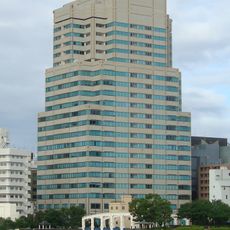
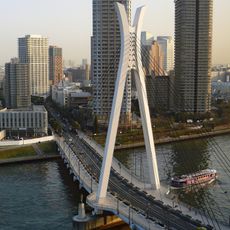
Eitai Bridge, Bridge in Kōtō and Chūō, Tokyo, Japan
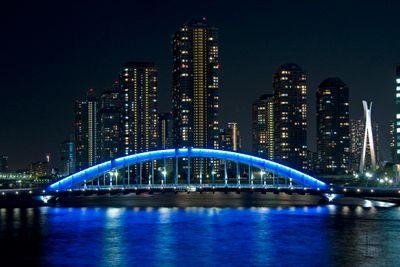
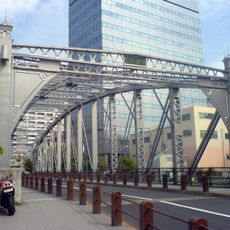
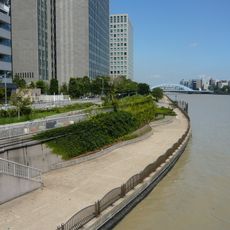
Eitai Bridge is a steel bridge across the Sumida River between Chūō and Kōtō wards in Tokyo. Its central span is a through steel arch, flanked by steel girder spans. The bridge is 184.7 metres long and 25 metres wide, carrying six lanes of traffic and walkways on both sides.
The first bridge opened on 1 August 1698, the fourth built across the Sumida, using surplus timber from the Kan'ei-ji main hall. On 20 September 1807, during the Fukagawa Hachiman festival, its crowded deck gave way and over 1,400 people died. The present steel bridge, begun in December 1923 and completed on 20 December 1926, was part of the post-Kantō earthquake reconstruction.
The name comes from Eitai Island, a former sandbank on the far bank where Eitai-ji temple already stood. A popular tale instead reads it as a wish that the Tokugawa shogunate would last for endless generations. In 1702 the 47 rōnin are said to have carried Kira's head across the bridge toward Sengaku-ji.
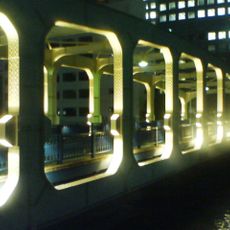
The bridge carries Tokyo Metropolitan Route 10 (Eitai-dori) across the Sumida River, linking Shinkawa 1-chome in Chuo ward on the west bank with Saga 1-chome and Eitai 1-chome in Koto ward on the east. Pedestrians walk on both sides of the deck; the bridge is lit from sunset until 21:00. The Tozai Line passes about 25 metres downstream, not directly beneath the bridge.
The bridge's lighting runs from sunset until 21:00, when the blue-white edge of the arch is switched on above the dark water. The structure was designed with input from architect Yamada Mamoru, and a scale model of the bridge as built is kept at the University of Tokyo's Faculty of Engineering Building 1.
The community of curious travelers
AroundUs brings together thousands of curated places, local tips, and hidden gems, enriched daily by 93,576 contributors worldwide.