Toyomibashi, Steel bridge over the Nihonbashi River in Chūō, Tokyo, Japan
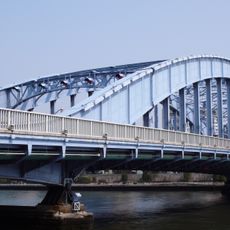
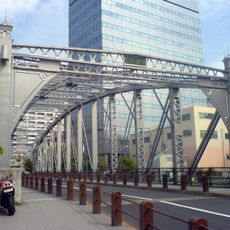
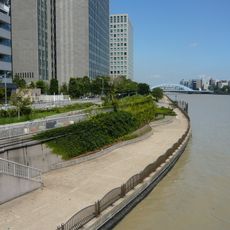
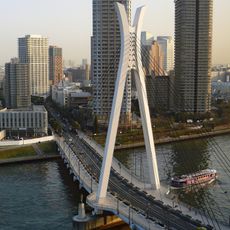
Toyomibashi is a 46.13 m long, 8 m wide steel bridge over the Nihonbashi River at its mouth where it meets the Sumida River, linking Nihonbashi-Hakozakicho on the north bank with Shinkawa 1-chome on the south bank in Chuo Ward, Tokyo. Its lower-deck Vierendeel truss, resembling a ladder laid on its side, retains riveted joints and is painted white.
A first bridge stood here from 1698, when a boat checkpoint guarded this mouth of the Nihonbashi River. After repeated collapses and fires, an iron truss bridge went up in 1903; it fell in the 1923 Great Kanto earthquake. The present bridge, designed by Takeo Fukuda and built by Yokogawa Bridge Works for the Reconstruction Bureau, was begun in May 1926 and finished in September 1927.
Locals call it Otomebashi, or Maiden Bridge, a name it carried since the Edo period. The white-painted steel is lit from evening in a pale orange, making it a lesser-known night-view spot, and television dramas are often filmed here. It was registered as a Tangible Cultural Property of Chuo Ward.
The bridge experiences heavy traffic during peak hours and can feel congested. Pedestrians have separate walkways that offer river views on clear days.
The bridge's name is misleading: Toyomi-chō in Chūō Ward lies more than 3 km away and has no direct connection to the bridge. The structure is also known as Otomebashi, and its ladder-like Vierendeel truss was designed by Takeo Fukuda to balance visually with the nearby Eitai Bridge.
The community of curious travelers
AroundUs brings together thousands of curated places, local tips, and hidden gems, enriched daily by 93,533 contributors worldwide.