Hinokichō Park, Neighbourhood park in Akasaka, Tokyo, Japan
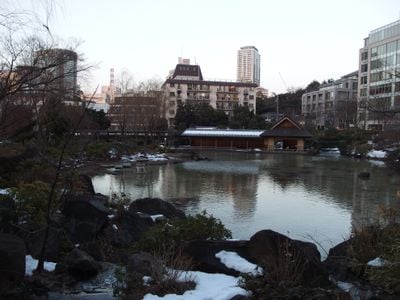
Hinokichō Park is a 14,100 m² municipal park in Akasaka, next to Tokyo Midtown. It is built around a pond and has a gazebo and play equipment named after the deities SANJIN, FUJIN and KAIJIN. The photograph shows a long, low wooden structure with a dark brown gabled roof and open bays on a dark stone base at the water's edge, with snow on the roof and ground.
The site was the lower residence of the Chōshū domain's Mōri family in the Edo period, whose garden, Shimizu-en, was famed among daimyō estates; many hinoki trees gave the mansion and later the district its name. In 1874 it became a garrison of the 1st Infantry Regiment, was requisitioned by US forces after 1945, and from 1960 housed the Defense Agency. Hinokichō Park opened as a metropolitan park in July 1963, passed to Minato Ward in 1968, and was re-landscaped in 2007 alongside Tokyo Midtown.
The name Hinokichō comes from the many hinoki cypress trees around the Mōri family's Edo-period lower residence, which was called Hinoki-yashiki. The park inherited the neighbourhood name. The residence garden, known as Shimizu-en, was counted among the famous daimyō gardens of Edo.
The park is easily accessible through multiple entrances and offers designated accessible pathways with level surfaces and seating areas. Visitors should be aware that certain sections may close temporarily for maintenance work.
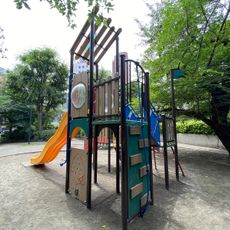
The park's playground equipment is named after Shinto wind, fire and sea deities: the slide is "SANJIN yama no kamisama", the swings "FUJIN kaze no kamisama" and the climbing frame "KAIJIN umi no kamisama". In 1986 a right-wing activist, Tadashi Nakamura, accidentally detonated a time bomb he had brought here and was seriously injured, an incident known as the Hinokichō Park case.
The community of curious travelers
AroundUs brings together thousands of curated places, local tips, and hidden gems, enriched daily by 93,421 contributors worldwide.