Seta no Karahashi, Road bridge in Otsu, Japan
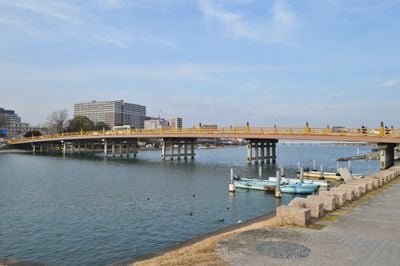
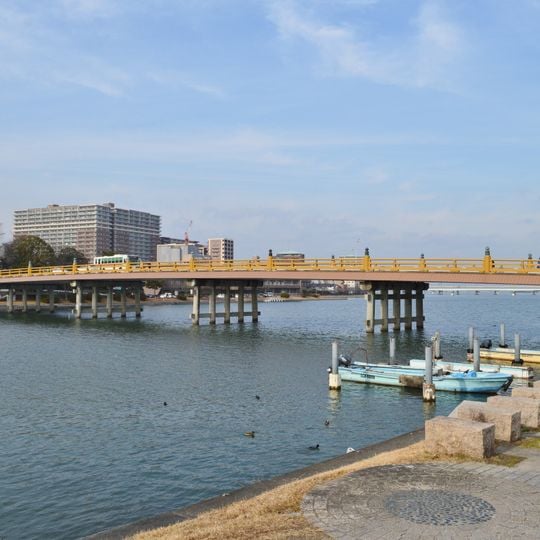
Seta no Karahashi is a road bridge in Otsu that spans the Seta River, connecting the two halves of the city. The deck rests on concrete piers with modern railings on both sides.
The first documented mention of a bridge here is in the Nihon Shoki, which records that in 672, during the Jinshin War, Prince Otomo's forces removed the bridge planks to block Prince Oama's army but were overrun. Excavated pier foundations about 80 m downstream, dated by dendrochronology to the late 7th century, are linked to the bridge built after the 667 move of the capital to Otsu. Oda Nobunaga rebuilt it in 1575, about 324 m long and 7.2 m wide, with the first bronze giboshi finials on its railing posts.
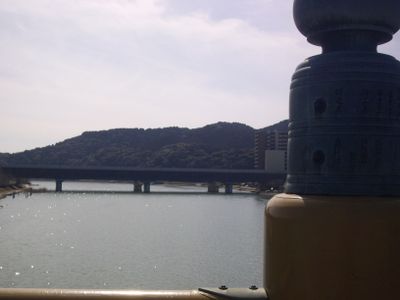
The bridge appears in the Eight Views of Omi as "Seta no Sekishō", the evening glow at Seta, painted by Utagawa Hiroshige. Its name is often linked to the proverb "isogaba maware" (hurry and go around): travellers bound for Kyoto preferred this wind-sheltered crossing over the faster but unreliable boat from Yabase. The bronze giboshi finials on the railing posts carry inscriptions such as "Bunsei" and "Meiji".
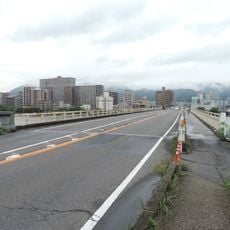
The bridge carries the Otsu-Notogawa-Nagahama prefectural road with one lane in each direction; a right-turn lane was added on the large span in March 2022. Traffic reached 11,955 vehicles on a weekday in a 2015 survey, so expect queues at the east-bank junction at commuting times and weekends. The nearest stop is Karahashi-mae on the Keihan Ishiyama-Sakamoto line.
The bridge's bronze giboshi finials, first fitted under Oda Nobunaga's 1575 rebuilding, have been handed down across generations; some still carry inscriptions such as "Bunsei" and "Meiji". The tea master Sen no Rikyu once asked his disciples to identify two especially fine finials, and Furuta Oribe rode to Seta to examine them.
The community of curious travelers
AroundUs brings together thousands of curated places, local tips, and hidden gems, enriched daily by 93,442 contributors worldwide.