Tsunoshima Bridge, Bridge in Shimonoseki, Japan
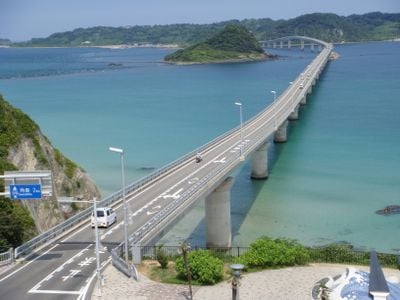
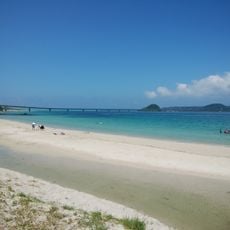
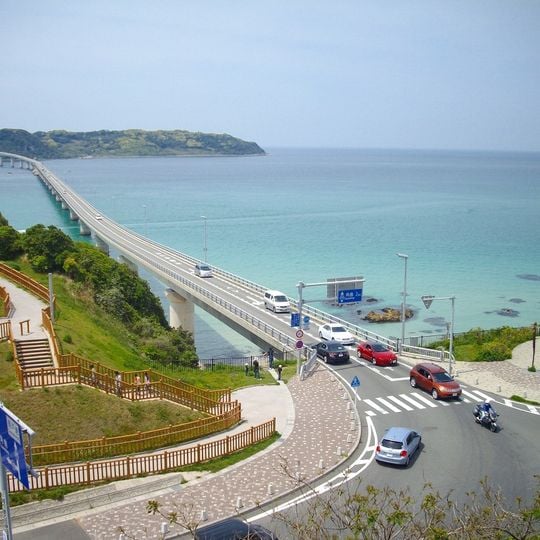
Tsunoshima Bridge is a 1,780-metre road bridge on Route 276 crossing the Amagase Strait in Shimonoseki, linking the mainland at Toyohoku-cho Kanda with Tsunoshima Island. Its pale grey concrete deck curves gently on thick cylindrical piers that widen into arches beneath the roadway, with a low concrete parapet along both sides. The route was set to bypass Hishima Island to spare the scenery of the Kita-Nagato Coast Quasi-National Park.
The crossing opened to traffic on November 3, 2000, establishing the first direct road connection to the island. Before that time, residents and visitors reached Tsunoshima only by small ferry boats that depended on weather conditions.
The bridge has appeared in television commercials for several carmakers, including Lexus, Mitsubishi, Suzuki and Nissan, and in dramas such as "Four Days' Miracle" and the HERO special. In 2015 a travel website's user-voted ranking of Japanese bridges placed it first. Around 900,000 people visit each year.
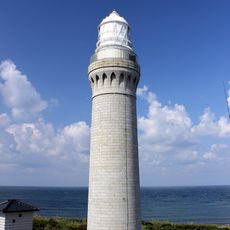
The bridge is part of Route 276 and has a speed limit of 40 km/h; in strong winds general vehicles are barred from crossing. The nearest bus stop is Hotel Sen-Nagato Resort Iriguchi, served from JR Takibe and Kotto stations toward Oyamai-no-ie. By car from Mine Interchange on the Chugoku Expressway, take Routes 435 and 191 and Route 275, about 60 minutes. Tsunoshima Lighthouse is about 5 km beyond the far end.
The bridge was Japan's longest toll-free island bridge when it opened in 2000, at 1,780 metres. It lost that status in 2005 to Kouri Bridge in Okinawa, which measures 1,960 metres. The route deliberately skirts Hatojima islet instead of crossing it, to protect the scenery of the Quasi-National Park.
The community of curious travelers
AroundUs brings together thousands of curated places, local tips, and hidden gems, enriched daily by 93,328 contributors worldwide.