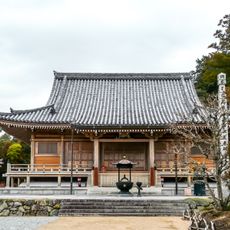
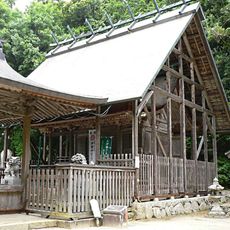
Takamefu-jinja, Shinto shrine in Japan
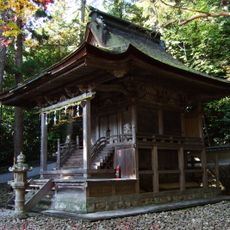
Takamefu-jinja is a Shinto shrine in Sanda, Hyogo Prefecture, whose main hall (honden) is a one-bay nagare-zukuri structure with a cypress-bark roof, rebuilt in 1513 according to a ridge tag. The hall and a pair of wooden komainu guardian dogs, carved from a single block of kaya wood and dated 1297, are both designated Important Cultural Properties of Japan. Subsidiary Ebisu and Inari shrines stand within the grounds.
Tradition credits the shrine's founding to the reign of Empress Suiko (592–628), and it may be linked to the nearby Mebu Shrine, another ancient shrine of Kawabe District. In the Heian period, Minamoto no Mitsunaka, who held large estates in the area, is said to have made it the district's main shrine and planted a zelkova tree. In 1736, the scholar Namikawa Seisho identified it as the Takamefu Shrine listed in the Engishiki, and it took its present name. In 1873 it was ranked as a district shrine, and in the late Meiji era it merged several village shrines.
The shrine was long known as Kage-no-Myōjin, Tsuki-no-miya or Sai-no-miya; a votive plaque reading "Shōichii Kage Daimyōjin", donated by Kyōto's Hōkyō-ji, hangs in the worship hall. On 7 October fathers of children born during the year, called hatsutō, pound rice to make chigiri-gohō offerings while singing a foundation-pounding song; on 9 October they carry the portable shrine.
Early mornings and late afternoons are the quietest times to visit, allowing you to experience the shrine without crowds. Keep noise to a minimum and observe how others behave to understand the proper way to show respect at the site.
The shrine's wooden komainu guardian dogs are carved from a single block of kaya wood and bear a date inscription of 1297, making them a National Important Cultural Property together with the main hall. The main hall itself was rebuilt in 1513, according to a ridge tag.
The community of curious travelers
AroundUs brings together thousands of curated places, local tips, and hidden gems, enriched daily by 94,366 contributors worldwide.